English
Views: 0 Author: Site Editor Publish Time: 2026-08-11 Origin: Site
Procuring advanced solid-liquid separation equipment represents a high-stakes decision for any industrial facility. Buyers face immense pressure to maximize daily throughput. You must also minimize the physical footprint of the installation. Achieving ultra-low cake moisture remains a top priority for most process engineers. During this complex procurement journey, you often encounter overlapping industry terminology. Many manufacturers use the general term "vertical filter press" interchangeably alongside the highly specific "Tower Filter Press." This nomenclature overlap creates severe confusion. It complicates vendor selection and risks costly mismatched equipment. We designed this comprehensive guide to clear up this ambiguity. It provides plant engineers and procurement teams an evidence-based evaluation framework. You will learn how to evaluate specific chamber configurations and assess distinct operational risks. We will help you model long-term financial viability and operating expenses beyond the initial capital expenditure. By the end of this guide, you can confidently select the exact architecture your slurry demands.
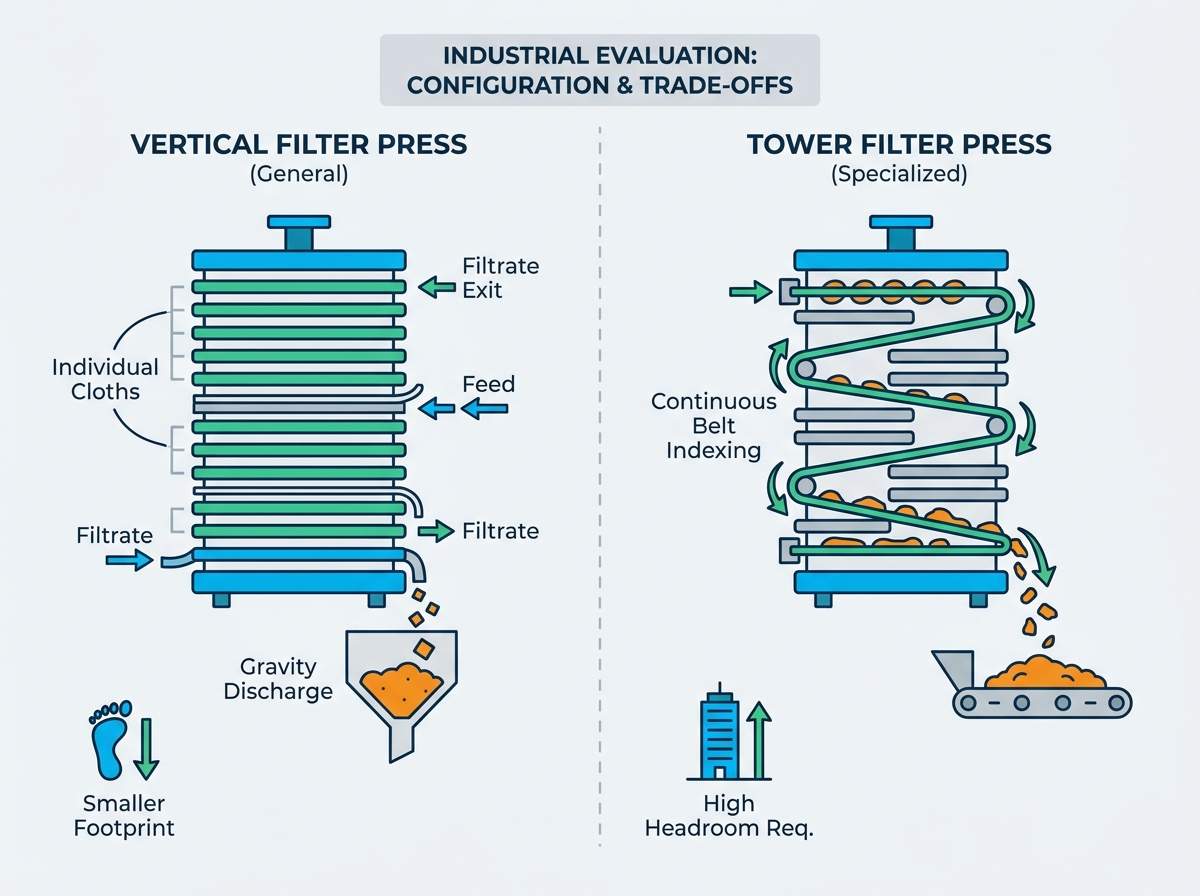
Nomenclature Clarity: A Tower Filter Press is a highly specialized subset of the vertical filter press family, typically characterized by continuous, single-belt indexing rather than individual plate cloths.
Primary Advantages: Both systems offer superior cake washing efficiency and a much smaller facility footprint compared to traditional horizontal plate-and-frame presses.
Operational Trade-offs: The high degree of automation and gravity-assisted discharge comes at the cost of increased vertical clearance requirements and complex hydraulic maintenance.
Decision Driver: Final selection should be dictated by specific slurry characteristics, required wash ratios, and lifecycle maintenance capabilities, validated through mandatory pilot testing.
The industrial shift toward vertical architectures stems from inherent limitations in traditional horizontal systems. Horizontal units demand massive floor space. They severely limit your facility layout options. They also struggle to distribute wash fluids evenly across vertical cakes. Gravity works against horizontal configurations during the crucial washing phase. Solid particles settle unevenly within the chambers. Upgrading to a vertical orientation solves many of these legacy issues instantly. It leverages gravity for uniform horizontal cake formation. This fundamental geometry change alters the entire efficiency profile of your filtration process.
Defining procurement success requires looking at highly specific operational metrics. You must evaluate these advanced systems against your facility's unique production constraints. We recommend focusing on three core criteria:
Footprint Optimization: Vertical configurations maximize your available filtration area per square meter. They free up valuable facility floor space for other downstream processes. This density proves critical in tightly packed chemical plants.
Automation & Labor: Modern processing facilities demand significantly less manual intervention. These systems drastically reduce operator involvement during the cake discharge cycle. Technicians no longer scrape plates by hand.
Product Recovery: Multi-stage cake washing achieves maximum solute recovery. You can extract highly valuable resources from the filter cake efficiently. This metric directly impacts your plant's overall profitability.
You must also identify the exact threshold for this capital investment. When does the premium cost of a vertical system become financially viable? High production volumes often justify the upgrade quickly. Strict moisture-content mandates also push buyers toward these advanced solutions. You need to calculate if your daily throughput warrants the higher initial expense. If your current horizontal setup causes a severe production bottleneck, upgrading makes pure financial sense. We strongly advise establishing a clear baseline of your current operating costs before evaluating new equipment. You cannot measure improvement without knowing your exact starting point.
Understanding technical distinctions prevents costly procurement errors. The industry routinely blurs the lines between general equipment categories and specialized subsets. You must know exactly what machinery you are evaluating.
The general category is the vertical filter press. In this robust design, heavy plates stack vertically on top of one another. The slurry feed enters from the top, bottom, or sides of the chamber. These versatile units can utilize individual filter cloths per chamber. They prove excellent for establishing uniform horizontal cake formation. Gravity heavily assists the downward discharge process when the heavy plates separate. This gravity-assisted discharge reduces the need for manual scraping tools. It keeps operators safer and reduces repetitive motion injuries.
Conversely, a Tower Filter Press represents a highly specialized sub-category. It features an endless, continuous filter cloth or belt. This belt zig-zags smoothly through the horizontally aligned, vertically stacked plates. During the discharge phase, the mechanism operates uniquely. The plates open simultaneously across the entire stack. The continuous belt then indexes forward automatically. This synchronized action discharges the cake from all chambers at the exact same time. It represents a marvel of mechanical synchronization.
This specialized continuous mechanism suits highly specific ideal use cases. High-throughput mining and metallurgy facilities rely heavily on it. Heavy chemical applications also benefit immensely from this design. They require rapid, simultaneous cake discharge and automated cloth washing. Continuous indexing minimizes cycle downtime significantly. It pushes maximum tonnage through the plant every single hour.
Review the comparison table below to clarify these mechanical differences.
Technical Feature | General Vertical Model | Specialized Tower Model |
|---|---|---|
Cloth Configuration | Individual cloths installed per chamber | Single continuous endless belt system |
Discharge Method | Sequential or batch dropping | Simultaneous belt indexing |
Ideal Application | Fine chemicals, specialty pharma | High-throughput mining, metallurgy |
Maintenance Focus | Individual cloth tracking and replacement | Complete belt tensioning and alignment |
Cycle Speed | Moderate to fast | Ultra-fast, continuous throughput |
Evaluating any industrial filter press requires connecting technical features to direct operational outcomes. Filtration and cake washing efficiency rank highly during this evaluation. Vertical chambers actively promote horizontal cake formation. Gravity keeps the solid particles distributed evenly across the entire filtration area. This uniform density actively prevents cake cracking during the wash phase. Intact cakes lead directly to superior wash fluid distribution. You avoid channeling completely. Channeling wastes expensive wash water and reduces final product purity. An even cake ensures every droplet of wash fluid performs useful work.
Cycle times and overall throughput also dictate system selection heavily. You must compare the continuous indexing speed of a specialized tower model against standard units. Standard vertical models often rely on sequential opening mechanisms. These batch processes add valuable minutes to every single cycle. Over a calendar year, these minutes compound into massive production losses. In contrast, continuous indexing sheds the cake rapidly. Faster cycles yield much higher daily production volumes. You extract more value from the exact same footprint.
You must also analyze energy and compressed air consumption carefully. High-pressure diaphragm squeezing demands significant electrical energy input. Large hydraulic pumps must generate immense force to squeeze the cakes. Furthermore, compressed air for cake blowing and drying adds another layer of utility demand. Industrial air compressors consume massive amounts of electricity. We advise measuring these high utility costs against the savings gained from producing a drier cake. Often, the thermal drying savings outweigh the compressed air costs.
Finally, consider facility integration carefully before signing a purchase order. You face a strict space versus height trade-off. These units save massive amounts of horizontal floor space. However, they demand significant vertical headroom to operate and maintain. You also need heavy-duty structural support grids. They must handle the stacked static weight and intense operational vibrations. Facility engineers often underestimate the structural steel requirements for these towering units. Do not make this expensive structural mistake.
We must address implementation realities transparently. Buyers often overlook severe operational risks during the excitement of the procurement phase. Maintenance complexity stands out as a primary hurdle for new adopters. You will need to service high-pressure hydraulic systems regularly. Complex manifolds and sensor arrays sit high off the ground. Technicians must work on elevated platforms to reach these critical components. This elevation slows down routine maintenance tasks considerably. It also requires stringent fall-protection safety protocols.
Consumables management presents another major operational risk category. The filter belt or cloth acts as the literal lifeblood of the system. You must monitor belt tracking issues constantly. Premature wear in continuous systems causes major production headaches. A slight misalignment destroys an expensive belt in hours. You must also consider replacement downtime carefully. Replacing a single continuous belt demands significant downtime and planning. It requires entirely different procedures than replacing individual chamber cloths. You must thread the heavy belt through complex roller systems perfectly. A mistake here ruins the consumable instantly.
Safety and compliance require rigorous, uncompromising attention. These automated systems utilize extreme high-pressure diaphragm squeezing. Operating pressures often reach 16 to 20 bar or more. Hazardous slurry containment becomes critical at these extreme pressures. A sudden seal failure releases toxic or scalding materials rapidly into the plant. You must evaluate the safety protocols, physical splash guards, and software interlocks built into the machine.
We maintain transparent assumptions about automation benefits. Automation definitely reduces daily manual labor requirements. Operators no longer scrape sticky plates by hand in hazardous environments. However, automation requires a much higher skill tier for your maintenance technicians. Your team must understand PLCs, advanced hydraulics, and precision laser tensioning systems. You essentially trade low-skilled manual labor for high-skilled technical troubleshooting. Ensure your maintenance budget reflects this necessary shift in personnel expertise.
Procurement teams need a strict shortlisting logic to navigate complex vendor proposals. Skipping these analytical steps leads directly to severe operational bottlenecks. We recommend following a defined three-step decision framework to ensure project success.
Step 1: Slurry Feasibility Testing. Bench-scale and pilot-scale testing remain absolutely non-negotiable. You cannot finalize equipment size or cloth type without them. Slurry characteristics vary wildly between different mineral seams or chemical batches. Pilot testing validates the required filtration area accurately. It prevents you from under-sizing the unit and missing production targets. Always demand hard data from a pilot plant run.
Step 2: CAPEX vs. OPEX Modeling. You must weigh the higher initial purchase and installation cost against long-term operational savings. Tower units cost significantly more upfront. However, they yield substantially drier cakes. Drier cakes drastically reduce downstream thermal drying costs. You also conserve significant amounts of wash water over the machine's lifecycle. Model these operating expense savings meticulously over a ten-year period.
Step 3: Vendor Evaluation Criteria. Not all manufacturers offer the exact same level of engineering expertise. Look for proven, industry-specific case studies. Mining tailings behave fundamentally differently than fine pharmaceutical chemicals. Assess the local availability of proprietary spare parts in your region. You need rapid access to control valves, endless belts, and rubber diaphragms. Evaluate the vendor's capability to deliver complete system integration. You want feed pumps, control systems, and structural skids packaged together. Standalone units leave the complex integration headache entirely to your internal team.
A common mistake during this phase involves skipping the slurry test entirely to save time. This shortcut almost always guarantees poor field performance. Laboratory data provides the only reliable foundation for your final procurement decision. Always demand a binding performance guarantee tied directly to the pilot test results.
Our final verdict hinges entirely on your facility's precise production requirements. The choice between a general vertical architecture and a specialized continuous indexing model depends on your cycle time demands. If your process demands continuous belt indexing and ultra-rapid cycles, the tower configuration wins easily. If you handle smaller, highly variable chemical batches, standard vertical plates offer better operational flexibility. Both systems provide incredible washing efficiency. Both options will save valuable floor space compared to legacy equipment.
We encourage you to take proactive action immediately. Initiate material testing and comprehensive slurry analysis with your shortlisted manufacturers. Send representative samples to their laboratories this week. Use these empirical laboratory results to lock in guaranteed performance metrics. Do not proceed to procurement until the vendor guarantees specific cake moisture and daily throughput targets in writing. Proper preparation and testing ensure your new separation equipment performs exactly as promised upon commissioning.
A: The lifespan varies significantly based on slurry abrasiveness and system operating pressure. Typically, continuous belts range from 1,000 to over 5,000 operational cycles. Highly abrasive mining tailings wear belts much faster than soft chemical precipitates. Proper hydraulic tensioning and strict adherence to automated cloth washing protocols will maximize this lifespan and prevent premature tearing.
A: It relies on a combination of uniform horizontal cake formation and high-pressure diaphragm squeezing. Gravity allows solid particles to settle evenly, eliminating thin spots. High-pressure rubber diaphragms then inflate. They physically squeeze the remaining interstitial liquid out of this uniform cake with intense forces often exceeding 16 bar.
A: Yes, you must account for much more than just the static machine height. You need significant overhead clearance for facility maintenance cranes. Technicians use these overhead cranes to lift heavy hydraulic cylinders and replacement plate packs. Failing to calculate this dynamic maintenance headroom leads to severe facility layout problems.
A: No, full machine replacement is generally required. The structural and hydraulic requirements differ fundamentally between the two designs. Vertical architectures demand vastly different load-bearing steel frames, automated manifolds, and complex control systems. Attempting a structural retrofit proves more expensive and much less reliable than installing a purpose-built system.