
Views: 0 Author: Site Editor Publish Time: 2026-07-30 Origin: Site
While a vertical filter press offers superior cycle times and cake washing capabilities compared to traditional designs, its automated, gravity-dependent mechanics require precise, proactive maintenance. You cannot simply ignore these systems and expect them to perform. They demand careful attention to prevent unplanned downtime. We must frame maintenance not as a minor housekeeping task, but as a strategic defense against premature equipment degradation and rising operational expenses. When you defer maintenance, you risk catastrophic failures that halt production entirely. This guide provides an evidence-based framework for maintaining your filtration equipment. You will learn how to troubleshoot common operational bottlenecks effectively. We will also help you evaluate exactly when to source replacement parts or professional OEM services. By following these steps, you can achieve maximum uptime and ensure your system operates at peak efficiency.
Routine dictates longevity: Daily hydraulic checks and disciplined filter cloth washing directly correlate with consistent cake dryness and reduced cycle times.
Component life is finite but optimizable: Implementing strict pressure ramp-up protocols prevents premature filter plate cracking and cloth blinding.
Troubleshooting requires systemic thinking: Most leakage or pressure drop issues stem from compounding minor faults (e.g., misaligned plates, degraded seals) rather than catastrophic failures.
Data-driven replacement: Deciding between localized repairs and comprehensive OEM overhauls should be based on cycle efficiency metrics and compliance requirements, not just component age.
Deferred maintenance in filtration systems creates compounded operational costs. When you ignore minor leaks, you face lower throughput and higher slurry moisture. Emergency downtime quickly destroys profit margins. Routine upkeep is essential to prevent these compounding failures. A well-maintained vertical filter press operates differently than horizontal models. It relies heavily on automated hydraulic sealing and gravity for cake discharge. If these systems fail, production stops immediately.
Gravity-dependent discharge mechanisms require perfectly functioning filter cloths. When cloths become blinded, cakes stick to the plates. This forces operators to intervene manually. Manual intervention drastically increases cycle times and exposes workers to safety hazards. Furthermore, automated hydraulic systems require precise pressure parameters. A minor seal degradation forces the hydraulic pump to run continuously. This overcompensation leads to premature pump failure and expensive repairs.
We must define clear success criteria for any maintenance program. A successful protocol ensures predictable performance and protects your capital investment. You should measure your maintenance success against these specific benchmarks:
Sustained target cake moisture levels: Consistent dewatering proves your cloths and feed pressures are optimal.
Zero unpredicted hydraulic pressure drops: Stable pressure indicates healthy seals, cylinders, and valves.
Extended intervals between major component overhauls: Proper daily care naturally delays the need for expensive structural replacements.
Maintenance schedules only work when tied to operator accountability. Checklists require operator signatures and rigorous managerial oversight. You must integrate these routines into daily shift changes. This ensures continuity and prevents minor issues from escalating into major faults.
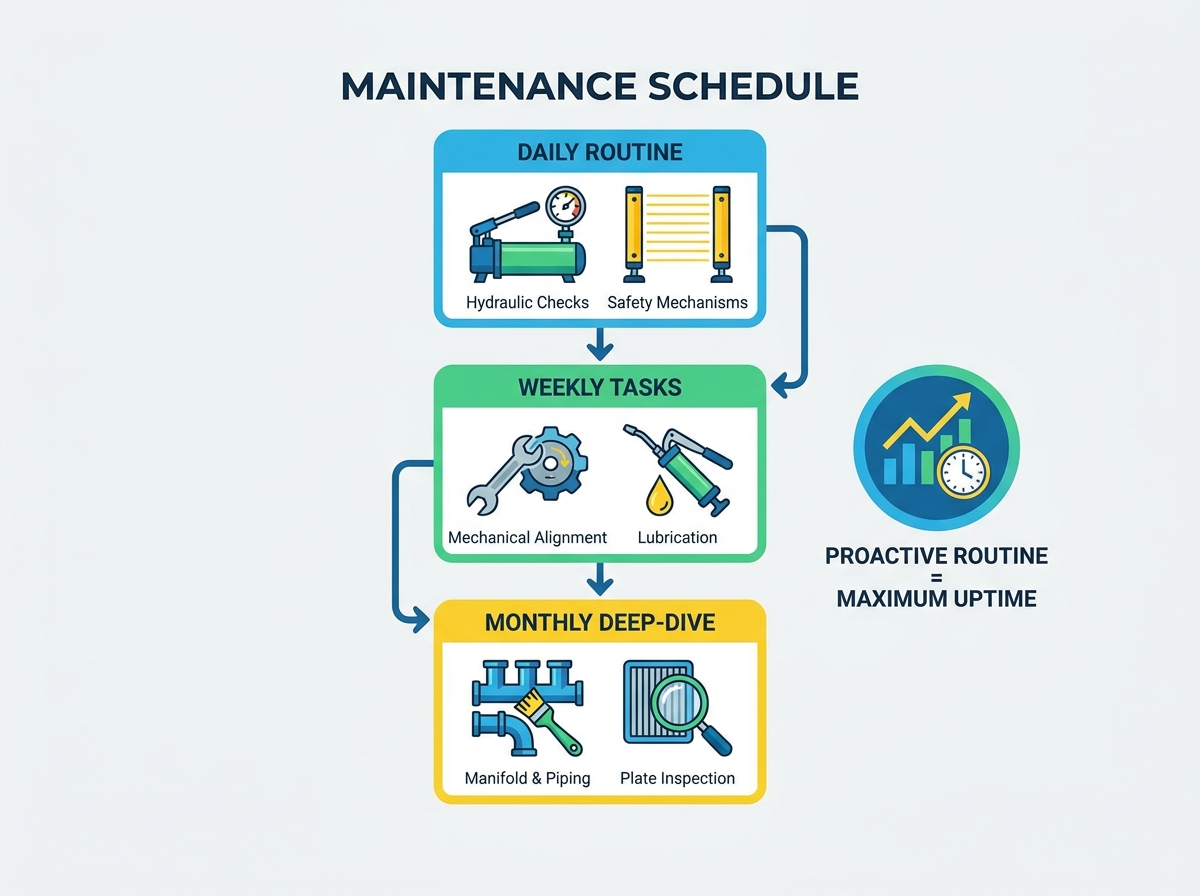
Your daily routine forms the first line of defense. Focus on the core systems governing pressure and safety. Hydraulic systems demand daily visual and functional inspections. You must inspect fluid levels through the reservoir sight glass. Look for physical leaks around hoses, fittings, and cylinders. Monitor the operating temperature closely during the filtration cycle. High temperatures destroy fluid viscosity. Degraded viscosity prevents the system from holding adequate clamping pressure.
Safety mechanisms are non-negotiable. Verify all safety devices before loading any slurry. Test the light curtains by deliberately breaking the beam. The system must halt immediately. Check all emergency stops and automated physical interlocks. They protect operators from the extreme crushing forces generated during the closing cycle. Never bypass a malfunctioning safety switch.
Weekly and monthly routines address progressive wear and tear. You must inspect slurry feed lines and filtrate discharge manifolds. Look for early signs of scale buildup. Mineral deposits cause severe flow blockages. Blockages create uneven pressure distribution across the filter plates. This uneven pressure leads directly to structural plate fractures.
Mechanical alignment requires monthly verification. Check the tensioning mechanisms and guide rails carefully. Use a laser level or precision calipers. They ensure plates close evenly and securely. Uneven closing causes dangerous pressure imbalances and slurry blowouts. Proper alignment distributes the clamping force equally across all sealing surfaces.
Lubrication requires a disciplined approach. Apply specified industrial lubricants to moving parts, chains, and sprockets. You must avoid over-lubrication at all costs. Excess oil or grease attracts abrasive environmental dust. This dust forms a grinding paste. The paste rapidly accelerates wear on your drive mechanisms.
Plates and cloths require the most frequent replacement in any filtration system. Their condition directly dictates your overall filtration efficiency. We must evaluate their wear patterns continuously to optimize performance.
Cloths act as the primary separation medium. They blind over time as fine particles become trapped in the woven fibers. You must establish a routine Clean-In-Place (CIP) schedule. Use appropriate chemical washes tailored to your specific slurry type. Mining slurries often require acidic washes to dissolve mineral scaling. Wastewater applications typically benefit from alkaline washes to remove organic fouling.
Never use high-pressure mechanical scraping on the cloths. Scraping tears the delicate cloth fibers and ruins permeability. It also distorts the fabric tension. Rely on automated cloth washing systems if your equipment includes them. Automated washers deliver consistent water pressure. They clean the fabric effectively without causing mechanical degradation.
Filter plates withstand massive hydraulic and internal feed pressures. You must monitor feed pressures continuously. Rapid pressure spikes cause dangerous differential pressure across the plate web. This differential force warps and cracks the polymer plates. Always ramp up the feed pump pressure gradually. This allows the cake to form an even protective layer.
Inspect sealing surfaces routinely. Check all O-rings and perimeter gaskets for physical damage. Look for chemical embrittlement or physical extrusion. A compromised seal allows slurry to bypass the chamber. It also forces the hydraulic system to overcompensate. Below is a comparative maintenance matrix to guide your inspection routines.
Component | Primary Failure Mode | Preventative Action | Inspection Frequency |
|---|---|---|---|
Filter Cloths | Particle blinding and fiber tearing | Routine CIP chemical washes; avoid scraping | Daily visual; Weekly deep clean |
Filter Plates | Stress fractures from differential pressure | Gradual feed pressure ramp-up | Monthly structural check |
Plate O-Rings | Chemical embrittlement and extrusion | Replace at first sign of hardening or leaks | Weekly visual inspection |
Hydraulic Seals | Pressure bypass and fluid leaks | Maintain clean hydraulic fluid; monitor temps | Daily monitoring |
Diagnosing faults requires a skeptical, engineering-first approach. Do not guess the cause of a failure. We recommend utilizing a Symptom-Cause-Solution framework for any filter press. This structured method prevents operators from treating symptoms rather than root causes.
Operators frequently complain about wet or excessively thin cakes. This issue dramatically increases downstream drying costs. You must identify the root cause quickly.
Likely Causes: Blinded filter cloths restrict filtrate flow. Insufficient feed pump pressure prevents proper chamber packing. Sometimes, operators prematurely terminate the drying cycle to rush production.
Actionable Fix: Initiate a deep chemical wash of the cloths immediately. Verify your feed pump flow rates against the original baseline specifications. Ensure the PLC timers allow for a complete air blow or membrane squeeze cycle.
Slurry blowouts present severe safety hazards and waste valuable product. They usually occur during the highest pressure phase of the feed cycle.
Likely Causes: Wrinkled or worn filter cloths prevent plates from sealing. Degraded plate seals or O-rings create microscopic bypass channels. Inadequate hydraulic closing pressure allows the plates to separate slightly.
Actionable Fix: Inspect the cloth installation for proper alignment and tension. Smooth out any wrinkles. Check the hydraulic system for internal bypass issues. Look for pressure leaks in the directional valves or main cylinders.
Vertical systems rely on gravity to drop the cake. When cakes stick, the entire automated sequence halts.
Likely Causes: Sticky cake usually results from incorrect chemical conditioning. An unbalanced flocculant dosage creates a slimy, unmanageable sludge. Alternatively, malfunctioning cloth drive mechanisms fail to agitate the fabric.
Actionable Fix: Re-evaluate your flocculant dosage and polymer selection. Conduct jar tests to find the optimal chemical balance. Inspect the pneumatic or mechanical actuators driving the cloth movement. Replace any bent guide pins or stretched drive chains.
Making objective replacement decisions protects your maintenance budget. You must avoid unnecessary up-sells from aggressive vendors. Follow a strict evaluation framework based on hard data. Minor seal leaks require inexpensive O-ring replacements. You can handle these repairs in-house. However, structural deformation in plates warrants full component replacement. Never attempt to machine or weld cracked polymer filter plates. Recurring hydraulic failures also require comprehensive overhauls by specialists.
We strongly advise against using aftermarket parts for critical components. Non-standard components often feature mismatched dimensional tolerances. A plate that is merely two millimeters off-spec causes systemic pressure issues over time. It unevenly distributes the clamping force, risking a catastrophic blowout. OEM parts guarantee reliability, precise fitment, and compliance assurance. They preserve your equipment warranty and ensure safe operation.
You should establish a critical spare parts inventory immediately. Do not wait for a failure to order long-lead items. Your on-site inventory must include extra cloths, full sets of O-rings, and reserve hydraulic fluid. You should also stock replacement safety light curtains and limit switches. Finally, schedule an annual preventative maintenance audit. Bring in certified OEM technicians. They possess the diagnostic tools necessary to evaluate hydraulic pump health and PLC programming integrity.
Maintaining a vertical filtration system demands continuous attention to operational pressures and mechanical alignment. We must preserve cloth permeability at all costs to ensure efficient cycle times. Proper hydraulic care prevents catastrophic safety hazards and production halts. Consistent maintenance translates directly to predictable production schedules. It protects your profit margins and extends the lifespan of your capital equipment.
Take immediate action to secure your operational stability. First, audit your current spare parts inventory to ensure you have critical seals and cloths on hand. Second, document your baseline feed pump flow rates to track future performance degradation. Finally, contact an engineering specialist to assess your current maintenance protocols and identify hidden vulnerabilities.
A: Replacement frequency varies heavily by application, typically ranging from one to six months. You should look for clear operational indicators rather than relying on a calendar. Replace cloths when you notice increased cycle times, persistent wet cakes, or unusually high initial feed pressures despite rigorous chemical washing.
A: The ideal pressure depends entirely on the OEM specifications and your specific plate design. Most industrial units range from 100 to 225 PSI. You must never exceed the manufacturer's rated limit to force faster dewatering. Exceeding this limit risks catastrophic plate failure and severe hydraulic system damage.
A: Pressure loss during the holding cycle usually indicates an internal leak within the hydraulic cylinder. It can also stem from a failing directional control valve or severely degraded hydraulic fluid. This requires immediate isolation and diagnostic testing to prevent continuous pump strain and eventual motor burnout.
The rubber belt vacuum filter is a high-efficiency filtration and solid-liquid separation equipment independently developed by our company on the basis of the introduction of foreign technology of similar products.
SGN Deep Cone Paste Thickener is mainly composed of deep taper, feeding device, stirring device, control box, drug delivery device and automatic control system. Slurry first enters the deaeration tank for processing, and then enters the swirling feeding tank. The pulp after flocculated in the feeding tank enters the dense sediment layer. By the reflocculation, filtration, and compression of the dense sediment layer, the clarified overflow water is discharged from the overflow weir and the high concentration underflow is discharged from the bottom cone.
The rubber belt vacuum filter is a high-efficiency filtration and solid-liquid separation equipment independently developed by our company on the basis of the introduction of foreign technology of similar products.
Tower/vertical press filter use air or water to form a huge pressure difference on both sides of filter cloth to achieve very efficient separation of solid and liquid.
GNZ centre drive efficient thickener is a kind of new-style solid-liquid separation equipment, and is designed by our company with the introduction of foreign advanced technology.
The rubber belt vacuum filter is a high-efficiency filtration and solid-liquid separation equipment independently developed by our company on the basis of the introduction of foreign technology of similar products.
Toncin horizontal rubber vacuum belt filter is a new-type, high-efficiency, and continuous-operation solid-liquid separation mechanical equipment developed by our company on the basis of introducing, digesting, and absorbing technologies of similar foreign products. At the same time, it is also a kind of mechanical equipment that fully utilizes the gravity and vacuum suction to achieve solid-liquid separation. In the structure, the vacuum zone is arranged in the horizontal direction, and the length of the vacuum zone can be continuously used to complete different processes such as filtration, washing, and blotting etc. It has the advantages of high filtration effect, large production capacity, good washing effect, wide application range, simple and smooth operation and convenient maintenance etc. It is particularly suitable for filtering suspension slurry with solid coarse particles, high density and filter cakes need to wash many times. It can be widely used in solid-liquid separation in metallurgy, mining, chemical, papermaking, food, pharmaceutical and environmental protection and other industrial sectors; and it particularly has a good application in the wet flue gas desulfurization gypsum dehydration (FGD).
Toncin belt filter press is a high-efficiency solid-liquid separation device based on the principles of chemical flocculation contact filtration and mechanical extrusion. It features a simple process flow, high automation, continuous operation, convenient control, and adjustable working parameters. When used in conjunction with a gravity thickener, it can eliminate the need for a material concentration tank, thereby saving construction costs to some extent. As a result, it is gaining increasingly widespread application across various industries.
Currently, the belt filter press is widely used for sludge dewatering in municipal sewage, textile printing and dyeing, electroplating, papermaking, leather, brewing, food processing, coal washing, petrochemicals, chemical industry, metallurgy, pharmaceuticals, ceramics, and other sectors. It is also suitable for solid-liquid separation or leaching processes in industrial production.
The SSPF smart row plate filter press is a fast opening and closing plate filter press which mainly consists of the electrical control system, hydraulic control system and the main engine.
ZPL series filter cloth type of disc dewatering machine has the advantages of small area, large processing capacity, low cost, easy large-scale, mature technology, reliable running and convenient operation, so it can be widely promoted in the field of desulfurization.
GNZ centre drive efficient thickener is a kind of new-style solid-liquid separation equipment, and is designed by our company with the introduction of foreign advanced technology.
The belt filter press is one kind of solid-liquid separation equipment that is useful to separate the solid particles with size more than micron to millimeter from the liquid (water). The advantages of this equipment is highly automation, simple and easy maintenance and low labour intensity.
Ceramic filter plate, also known as ceramic filter, ceramic plate and filter plate, is a new filter medium made of corundum and silicon carbide by special techniques. Our ceramic filter plates have been widely used in the filter dewatering of iron concentrate, zinc concentrate, copper concentrate, nickel concentrate, aluminum concentrate, gold concentrate, and other non-metallic concentrates and the solid-liquid separation of coal, fine chemical engineering, paper, pharmaceutical, chemical fiber, food, environmental protection and other sectors.
HVPF vertical automatic press filter is the most advanced filter that the world has ever get. Vacuum has a limit, but Pressure not. HVPF vertical automatic press filter use air or water to form a huge pressure difference on both sides of filter cloth to achieve very efficient separation of solid and liquid.
Toncin horizontal rubber vacuum belt filter is a new-type, high-efficiency, and continuous-operation solid-liquid separation mechanical equipment developed by our company on the basis of introducing, digesting, and absorbing technologies of similar foreign products. At the same time, it is also a kind of mechanical equipment that fully utilizes the gravity and vacuum suction to achieve solid-liquid separation. In the structure, the vacuum zone is arranged in the horizontal direction, and the length of the vacuum zone can be continuously used to complete different processes such as filtration, washing, and blotting etc. It has the advantages of high filtration effect, large production capacity, good washing effect, wide application range, simple and smooth operation and convenient maintenance etc. It is particularly suitable for filtering suspension slurry with solid coarse particles, high density and filter cakes need to wash many times. It can be widely used in solid-liquid separation in metallurgy, mining, chemical, papermaking, food, pharmaceutical and environmental protection and other industrial sectors; and it particularly has a good application in the wet flue gas desulfurization gypsum dehydration (FGD).
The DU rubber belt vacuum filter operates by utilizing vacuum negative pressure to achieve solid-liquid separation. Its filtration section is horizontally arranged, allowing for continuous processes such as filtration, washing, blotting, and filter cloth regeneration. This equipment boasts high filtration efficiency, a large production capacity, effective washing capabilities, a low water content in the filter cake, flexible operation, and minimal maintenance costs.
GNZ centre drive efficient thickener is a kind of new-style solid-liquid separation equipment, and is designed by our company with the introduction of foreign advanced technology.
HVPF vertical automatic press filter is the most advanced filter that the world has ever get. Vacuum has a limit, but Pressure not. HVPF vertical automatic press filter use air or water to form a huge pressure difference on both sides of filter cloth to achieve very efficient separation of solid and liquid.
Toncin GNZ centre drive efficient thickener is a kind of new-style solid-liquid separation equipment, and is designed by our company with the introduction of foreign advanced technology.
HVPF vertical automatic press filter is the most advanced filter that the world has ever get. Vacuum has a limit, but Pressure not. HVPF vertical automatic press filter use air or water to form a huge pressure difference on both sides of filter cloth to achieve very efficient separation of solid and liquid.
GNZ centre drive efficient thickener is a kind of new-style solid-liquid separation equipment, and is designed by our company with the introduction of foreign advanced technology.
Rubber filter belt is also called rubber drainage belt (vacuum belt), it is key part of vacuum belt filter(HVBF or VBF). The Carcass material of belt is PE/EE, which has excellent qualities like high strength, anti-acid/alkali/petrol/low and high temperature, and the most outstanding feature is low elongation rate under specified load, this can make sure the fabric is not easy to deform.
TC series ceramic vacuum filter is a new type high-effect, energy saving filtration equipment, using vacuum and ceramic plate with micro-holes for solid-liquid separation. The plate material is corundum, resisting to almost all temperatures, and has a long operation life. The micro-holes in plates only allows liquid to flow through but not air and solid. Filtrate is drawn through the ceramic plates as they are immersed into the slurry cabin, and cakes forms on the surface of the Plates.
Belt Filter Press sludge dewatering machine
Warranty: 1 Year
Certification: CE/ISO 9001/ IS0 14001
Capacity: customized
After Warranty Service: Field maintenance and repair service
The DU rubber belt vacuum filter is equipment that realizes solid-liquid separation with vacuum negative pressure as driving force.The equipment has the advantages of high filtration efficiency, large production capacity, good washing effect, low water content of the filter cake, flexible operation and low maintenance cost etc. It can be widely used for solid-liquid separation in the fields of metallurgy, mining, chemical, papermaking, food, pharmacy and environmental protection etc. and it particularly has a good application in the flue gas desulfurization gypsum dehydration (FGD).
The rubber belt vacuum filter is a high-efficiency filtration and solid-liquid separation equipment independently developed by our company on the basis of the introduction of foreign technology of similar products.
TC series ceramic vacuum filter is a new type high-effect, energy saving filtration equipment, using vacuum and ceramic plate with micro-holes for solid-liquid separation. The plate material is corundum, resisting to almost all temperatures, and has a long operation life. The micro-holes in plates only allows liquid to flow through but not air and solid. Filtrate is drawn through the ceramic plates as they are immersed into the slurry cabin, and cakes forms on the surface of the Plates.
Ceramic filter plate, also known as ceramic filter, ceramic plate and filter plate, is a new filter medium made of corundum and silicon carbide by special techniques. Our ceramic filter plates have been widely used in the filter dewatering of iron concentrate, zinc concentrate, copper concentrate, nickel concentrate, aluminum concentrate, gold concentrate, and other non-metallic concentrates and the solid-liquid separation of coal, fine chemical engineering, paper, pharmaceutical, chemical fiber, food, environmental protection and other sectors.
Email: toncinfilter@toncin.com