
Views: 0 Author: Site Editor Publish Time: 2026-06-27 Origin: Site
In continuous solid-liquid separation, finding the precise operational balance is the difference between highly efficient production and costly bottlenecks. Minor adjustments ripple through the entire plant operation. Operators frequently struggle to balance maximum throughput with target cake moisture. The master variable controlling this equilibrium is the vacuum belt filter belt speed.
Running a system too fast ruins dewatering capabilities. Conversely, letting it crawl restricts yields and wastes energy. Optimizing this speed requires a deep understanding of how residence time affects the filtration cycle, interacts with vacuum energy, and dictates overall equipment ROI. This guide breaks down the engineering trade-offs and evaluation criteria for optimizing belt speed in modern filtration systems. You will learn actionable steps to hit peak performance.
Speed Dictates Residence Time: Belt speed directly controls the duration a slurry spends in the cake formation, washing, and dewatering zones.
The Velocity Trade-off: High speeds increase theoretical throughput but risk wet, unpeelable cakes and lateral overflow. Lower speeds yield highly solid, easily discharged cakes at the cost of total capacity.
Interdependent Variables: Belt speed must be calibrated alongside vacuum level, slurry feed rate, and chemical dosing (flocculants) for optimal performance.
Modern Evaluation Criteria: When upgrading or evaluating a rubber belt vacuum filter, look for variable frequency drives (VFDs) and automated tracking systems that safely support dynamic speed adjustments.
Belt speed determines the exact exposure time of the filter cloth and slurry to the vacuum source. This metric spans the equipment's entire length. Every meter of travel dictates final cake quality. Operators must treat velocity as a primary performance lever. You cannot simply set it and forget it.
Modern equipment divides the process into five specific operational zones. Velocity impacts each zone differently. When you adjust the speed of your vacuum belt filter, you alter the fundamental chemistry and physics happening on the cloth.
Slurry Pooling: The initial feed box distributes mud across the cloth. Speed dictates how fast the liquid spreads before vacuum suction activates.
Cake Formation: Fast speeds shorten this window. Capillary water must draw through the continuous filter cloth rapidly. If the belt moves too quickly, the initial cake forms unevenly.
Cake Washing: This stage uses either co-current or counter-current washing. Speed sets the time available for wash liquids to displace the mother liquor. Engineers call this plug flow displacement. Too fast, and impurities remain trapped. Too slow, and you waste valuable wash water.
Cake Dewatering: Speed dictates final moisture content. The vacuum extracts remaining free water here. Slower travel ensures maximum air pull through the solids.
Cake Discharge: A well-optimized speed ensures the cake is dry enough to easily peel away. Wet cakes stick to the discharge roller and blind the cloth pores.
Successful separation requires balancing four interdependent levers. Belt speed operates alongside them.
Belt Speed: Controls total residence time.
Vacuum Level: Dictates the driving force pulling liquid through the cloth.
Cake Thickness: Determines how difficult air passage becomes.
Wash Water Volume: Affects purity and downstream drying requirements.
Operators often push machinery to extremes. They seek higher ton-per-hour yields or ultra-dry cakes. Both extremes carry significant engineering risks.
Pushing velocity too high introduces compounding failures. Insufficient dewatering happens first. Capillary water lacks the necessary time to convert into free water. You end up with a low-solid, wet cake.
Discharge failures follow closely. Sticky, wet cakes are notoriously difficult to scrape off the cloth. They cling to the fabric. This leads to rapid cloth blinding. It also increases mechanical wear on the scraper blades.
Physical constraints also limit maximum velocity. Industry standards often cap speeds around 5 m/min depending on specific gravity. Exceeding optimal thresholds severely reduces time in the gravity dewatering zone. Liquid cannot drain fast enough. Mud inevitably spills over the rubber edges. Engineers call this lateral overflow.
Operating too slowly presents different challenges. Throughput bottlenecks become immediately apparent. The machine produces a highly dense, easily discharged cake. However, overall yield drops significantly. The facility fails to meet production quotas.
Energy inefficiencies pose a deeper problem. Vacuum pumps account for up to two-thirds of filtration energy costs. Operating slowly while pulling maximum vacuum wastes massive amounts of power. A thin, slow-moving cake often cracks. Air rushes through these cracks. The vacuum pump works harder just to maintain pressure, unnecessarily driving up OPEX.
Speed Condition | Cake Moisture | Throughput (Capacity) | Primary Operational Risks |
|---|---|---|---|
Excessive Speed | High (Wet Cake) | High (Theoretical) | Lateral overflow, cloth blinding, discharge failures. |
Optimal Speed | Target Moisture | Balanced | Requires active monitoring and automated adjustments. |
Over-Slowing | Low (Dry Cake) | Low | Energy waste, cake cracking, throughput bottlenecks. |
Velocity cannot be calibrated in a vacuum. Operators must align it with upstream conditions. Slurry characteristics dictate the baseline speed parameters.
The total capacity of a belt filter is a product of mud input volume and solid load. Speed must adjust dynamically if upstream slurry density fluctuates. Standard industrial applications typically require a slurry density greater than 1.8. If density drops, more water enters the system. You must slow the belt to allow extra drainage time. If density rises, you can increase speed safely.
Proper belt speed assumes optimal flocculant use. Chemicals aggregate fine particles into larger flocs. This process releases bound capillary water. If chemical dosing falls short, water remains trapped inside the mud.
Slowing the belt will not cure high moisture content caused by poor dosing. You cannot physically vacuum out chemically bound water. Operators often slow the machine, see no improvement, and assume the equipment is faulty.
Effective troubleshooting requires isolating variables. Establish the optimal chemical dosage first in a lab setting. Once flocculant levels are locked, incrementally adjust belt speed. Find the maximum viable throughput without compromising cake dryness. Never adjust dosing and speed simultaneously.
Legacy equipment lacks the agility for modern speed optimization. Older machines rely on fixed gearboxes. They struggle to adapt to changing upstream slurry conditions. When shortlisting new equipment, evaluate specific automation features.
Modern systems integrate Variable Frequency Drives on the main drive motor. VFDs allow continuous, highly responsive step-less speed regulation. Operators can dial in exact speeds down to the decimal. VFDs also reduce mechanical shock during startup. They pull less initial current, preserving motor longevity.
Higher belt speeds amplify misalignment risks. Uneven load distribution or roller wear pushes the heavy rubber belt off-center. We call this a tracking issue.
A high-tier machine must feature responsive, automated tracking devices. Pneumatic sensors detect belt drift instantly. They trigger guide rollers to correct the path. Reliable tensioning systems prevent belt damage during dynamic speed shifts. If you adjust velocity rapidly without automated tensioning, the belt slips or stretches.
Upgrading drive motors for higher speeds without installing automated tracking systems is dangerous. Faster speeds multiply tracking errors. Manual tracking cannot keep up, leading to shredded belt edges.
Operating at optimized speeds requires a low-friction support bed. The heavy rubber belt drags across a vacuum box. This drag consumes immense motor power. Evaluate how the equipment mitigates this friction.
Roller Deck Supports: These use internal bearing rollers. They offer extremely low friction and require less motor energy. They excel at high speeds but require more moving parts.
Water-Lubricated Belt Slides: These use a sacrificial wear belt riding on a cushion of water. They feature fewer moving parts and boast high reliability. However, they consume operational water to maintain lubrication.
Optimizing vacuum belt filter belt speed requires constant attention. It is an ongoing process of balancing throughput demands against final cake quality and equipment wear. Facility managers must look beyond single metrics. Optimization requires holistic adjustments of feed rates, vacuum pressure, and belt velocity.
Consider the following next steps for your facility:
Conduct pilot-unit tests or laboratory trials to benchmark your current speed settings.
Isolate flocculant dosing from mechanical settings during your next troubleshooting session.
Evaluate your current drive systems. Plan upgrades to VFDs if you rely on static gearboxes.
Inspect tracking mechanisms to ensure they can handle dynamic speed shifts safely.
A: Maximum speeds vary heavily by manufacturer, specific application, and material. While some high-capacity systems report speeds up to 70 ft/min, typical heavy-duty industrial applications often restrict velocity. Operators usually keep it under 5 m/min. This prevents lateral slurry overflow and ensures adequate gravity dewatering time.
A: Running a belt too slowly creates a thin cake. Thin cakes crack easily, causing air leaks and lowering the pressure differential. The vacuum pump is then forced to work harder to maintain suction. Optimizing speed maintains consistent cake thickness, seals the vacuum effectively, and reduces unnecessary energy draw.
A: Not directly. Slowing down the belt produces a drier cake that discharges more cleanly, leaving less residue. However, chronic blinding is usually an issue of incorrect cloth selection. It also stems from inadequate high-pressure cloth washing at the discharge zone or improper flocculant dosing.
A: Increasing speed reduces the time your slurry spends in the initial gravity dewatering and pooling zones. If the vacuum cannot draw down the free liquid fast enough before the belt moves forward, liquid accumulates. It eventually spills over the sides of the rubber belt.
The rubber belt vacuum filter is a high-efficiency filtration and solid-liquid separation equipment independently developed by our company on the basis of the introduction of foreign technology of similar products.
SGN Deep Cone Paste Thickener is mainly composed of deep taper, feeding device, stirring device, control box, drug delivery device and automatic control system. Slurry first enters the deaeration tank for processing, and then enters the swirling feeding tank. The pulp after flocculated in the feeding tank enters the dense sediment layer. By the reflocculation, filtration, and compression of the dense sediment layer, the clarified overflow water is discharged from the overflow weir and the high concentration underflow is discharged from the bottom cone.
The rubber belt vacuum filter is a high-efficiency filtration and solid-liquid separation equipment independently developed by our company on the basis of the introduction of foreign technology of similar products.
Tower/vertical press filter use air or water to form a huge pressure difference on both sides of filter cloth to achieve very efficient separation of solid and liquid.
GNZ centre drive efficient thickener is a kind of new-style solid-liquid separation equipment, and is designed by our company with the introduction of foreign advanced technology.
The rubber belt vacuum filter is a high-efficiency filtration and solid-liquid separation equipment independently developed by our company on the basis of the introduction of foreign technology of similar products.
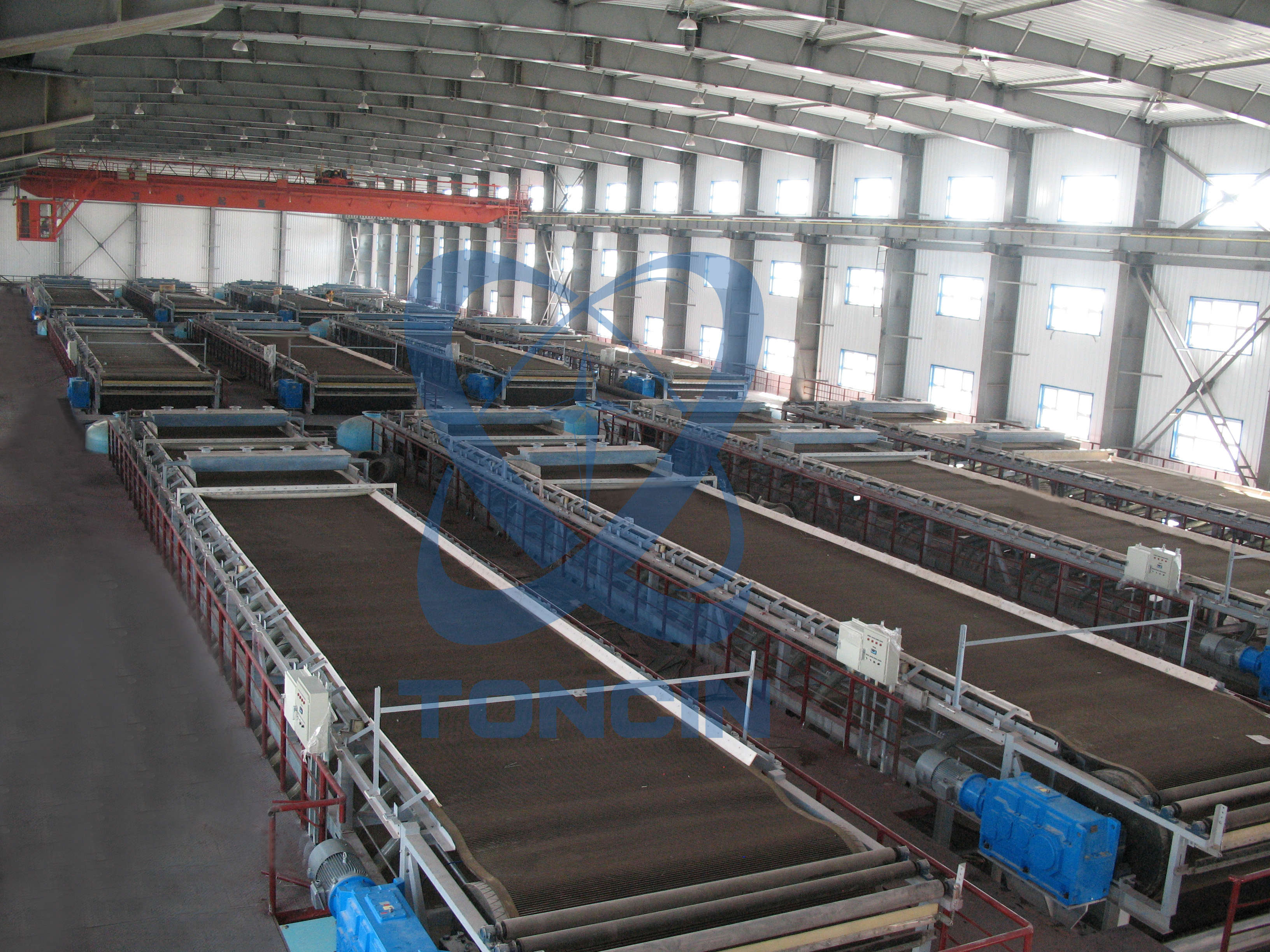
Toncin horizontal rubber vacuum belt filter is a new-type, high-efficiency, and continuous-operation solid-liquid separation mechanical equipment developed by our company on the basis of introducing, digesting, and absorbing technologies of similar foreign products. At the same time, it is also a kind of mechanical equipment that fully utilizes the gravity and vacuum suction to achieve solid-liquid separation. In the structure, the vacuum zone is arranged in the horizontal direction, and the length of the vacuum zone can be continuously used to complete different processes such as filtration, washing, and blotting etc. It has the advantages of high filtration effect, large production capacity, good washing effect, wide application range, simple and smooth operation and convenient maintenance etc. It is particularly suitable for filtering suspension slurry with solid coarse particles, high density and filter cakes need to wash many times. It can be widely used in solid-liquid separation in metallurgy, mining, chemical, papermaking, food, pharmaceutical and environmental protection and other industrial sectors; and it particularly has a good application in the wet flue gas desulfurization gypsum dehydration (FGD).
Toncin belt filter press is a high-efficiency solid-liquid separation device based on the principles of chemical flocculation contact filtration and mechanical extrusion. It features a simple process flow, high automation, continuous operation, convenient control, and adjustable working parameters. When used in conjunction with a gravity thickener, it can eliminate the need for a material concentration tank, thereby saving construction costs to some extent. As a result, it is gaining increasingly widespread application across various industries.
Currently, the belt filter press is widely used for sludge dewatering in municipal sewage, textile printing and dyeing, electroplating, papermaking, leather, brewing, food processing, coal washing, petrochemicals, chemical industry, metallurgy, pharmaceuticals, ceramics, and other sectors. It is also suitable for solid-liquid separation or leaching processes in industrial production.
The SSPF smart row plate filter press is a fast opening and closing plate filter press which mainly consists of the electrical control system, hydraulic control system and the main engine.
ZPL series filter cloth type of disc dewatering machine has the advantages of small area, large processing capacity, low cost, easy large-scale, mature technology, reliable running and convenient operation, so it can be widely promoted in the field of desulfurization.
GNZ centre drive efficient thickener is a kind of new-style solid-liquid separation equipment, and is designed by our company with the introduction of foreign advanced technology.
The belt filter press is one kind of solid-liquid separation equipment that is useful to separate the solid particles with size more than micron to millimeter from the liquid (water). The advantages of this equipment is highly automation, simple and easy maintenance and low labour intensity.
Ceramic filter plate, also known as ceramic filter, ceramic plate and filter plate, is a new filter medium made of corundum and silicon carbide by special techniques. Our ceramic filter plates have been widely used in the filter dewatering of iron concentrate, zinc concentrate, copper concentrate, nickel concentrate, aluminum concentrate, gold concentrate, and other non-metallic concentrates and the solid-liquid separation of coal, fine chemical engineering, paper, pharmaceutical, chemical fiber, food, environmental protection and other sectors.
HVPF vertical automatic press filter is the most advanced filter that the world has ever get. Vacuum has a limit, but Pressure not. HVPF vertical automatic press filter use air or water to form a huge pressure difference on both sides of filter cloth to achieve very efficient separation of solid and liquid.
Toncin horizontal rubber vacuum belt filter is a new-type, high-efficiency, and continuous-operation solid-liquid separation mechanical equipment developed by our company on the basis of introducing, digesting, and absorbing technologies of similar foreign products. At the same time, it is also a kind of mechanical equipment that fully utilizes the gravity and vacuum suction to achieve solid-liquid separation. In the structure, the vacuum zone is arranged in the horizontal direction, and the length of the vacuum zone can be continuously used to complete different processes such as filtration, washing, and blotting etc. It has the advantages of high filtration effect, large production capacity, good washing effect, wide application range, simple and smooth operation and convenient maintenance etc. It is particularly suitable for filtering suspension slurry with solid coarse particles, high density and filter cakes need to wash many times. It can be widely used in solid-liquid separation in metallurgy, mining, chemical, papermaking, food, pharmaceutical and environmental protection and other industrial sectors; and it particularly has a good application in the wet flue gas desulfurization gypsum dehydration (FGD).
The DU rubber belt vacuum filter operates by utilizing vacuum negative pressure to achieve solid-liquid separation. Its filtration section is horizontally arranged, allowing for continuous processes such as filtration, washing, blotting, and filter cloth regeneration. This equipment boasts high filtration efficiency, a large production capacity, effective washing capabilities, a low water content in the filter cake, flexible operation, and minimal maintenance costs.
GNZ centre drive efficient thickener is a kind of new-style solid-liquid separation equipment, and is designed by our company with the introduction of foreign advanced technology.
HVPF vertical automatic press filter is the most advanced filter that the world has ever get. Vacuum has a limit, but Pressure not. HVPF vertical automatic press filter use air or water to form a huge pressure difference on both sides of filter cloth to achieve very efficient separation of solid and liquid.
Toncin GNZ centre drive efficient thickener is a kind of new-style solid-liquid separation equipment, and is designed by our company with the introduction of foreign advanced technology.
HVPF vertical automatic press filter is the most advanced filter that the world has ever get. Vacuum has a limit, but Pressure not. HVPF vertical automatic press filter use air or water to form a huge pressure difference on both sides of filter cloth to achieve very efficient separation of solid and liquid.
GNZ centre drive efficient thickener is a kind of new-style solid-liquid separation equipment, and is designed by our company with the introduction of foreign advanced technology.
Rubber filter belt is also called rubber drainage belt (vacuum belt), it is key part of vacuum belt filter(HVBF or VBF). The Carcass material of belt is PE/EE, which has excellent qualities like high strength, anti-acid/alkali/petrol/low and high temperature, and the most outstanding feature is low elongation rate under specified load, this can make sure the fabric is not easy to deform.
TC series ceramic vacuum filter is a new type high-effect, energy saving filtration equipment, using vacuum and ceramic plate with micro-holes for solid-liquid separation. The plate material is corundum, resisting to almost all temperatures, and has a long operation life. The micro-holes in plates only allows liquid to flow through but not air and solid. Filtrate is drawn through the ceramic plates as they are immersed into the slurry cabin, and cakes forms on the surface of the Plates.
Belt Filter Press sludge dewatering machine
Warranty: 1 Year
Certification: CE/ISO 9001/ IS0 14001
Capacity: customized
After Warranty Service: Field maintenance and repair service
The DU rubber belt vacuum filter is equipment that realizes solid-liquid separation with vacuum negative pressure as driving force.The equipment has the advantages of high filtration efficiency, large production capacity, good washing effect, low water content of the filter cake, flexible operation and low maintenance cost etc. It can be widely used for solid-liquid separation in the fields of metallurgy, mining, chemical, papermaking, food, pharmacy and environmental protection etc. and it particularly has a good application in the flue gas desulfurization gypsum dehydration (FGD).
The rubber belt vacuum filter is a high-efficiency filtration and solid-liquid separation equipment independently developed by our company on the basis of the introduction of foreign technology of similar products.
TC series ceramic vacuum filter is a new type high-effect, energy saving filtration equipment, using vacuum and ceramic plate with micro-holes for solid-liquid separation. The plate material is corundum, resisting to almost all temperatures, and has a long operation life. The micro-holes in plates only allows liquid to flow through but not air and solid. Filtrate is drawn through the ceramic plates as they are immersed into the slurry cabin, and cakes forms on the surface of the Plates.
Ceramic filter plate, also known as ceramic filter, ceramic plate and filter plate, is a new filter medium made of corundum and silicon carbide by special techniques. Our ceramic filter plates have been widely used in the filter dewatering of iron concentrate, zinc concentrate, copper concentrate, nickel concentrate, aluminum concentrate, gold concentrate, and other non-metallic concentrates and the solid-liquid separation of coal, fine chemical engineering, paper, pharmaceutical, chemical fiber, food, environmental protection and other sectors.
Email: toncinfilter@toncin.com