English
Views: 0 Author: Site Editor Publish Time: 2026-08-03 Origin: Site
Industrial manufacturing processes rely heavily on efficient solid-liquid separation. A highly automated, gravity-assisted system effectively redefines these demanding operations. Today, modern industrial facilities constantly struggle to minimize equipment footprints. They frequently demand lower cake moisture levels and significantly reduced manual intervention. Traditional separation methods often fall short in these critical areas, creating persistent production bottlenecks. Solving these pressing challenges directly improves plant efficiency and overall workplace safety.
We will explore how evaluating this specific separation architecture compares against traditional horizontal models. You will learn how it impacts long-term operational workflows, maintenance routines, and facility design. We also cover core mechanical principles, engineering benefits, and primary industry applications. Upgrading your plant equipment demands careful analysis of specific process requirements. We provide actionable insights to guide your strategic procurement decisions.
Definition: A vertical filter press stacks filter plates horizontally but operates on a vertical axis, utilizing gravity and pneumatic pressure for efficient filtration and automated cake discharge.
Core Advantage: Delivers up to a 50% smaller footprint and significantly lower cake moisture compared to conventional plate-and-frame models.
Best Fit: Ideal for high-throughput industries like mining, chemical processing, and complex wastewater treatment where fine particle separation and automated enclosed processing are critical.
Decision Factor: While initial capital expenditure (CapEx) is higher, the ROI is realized through reduced labor costs, faster cycle times, and lower thermal drying requirements.
The structural design of this machinery differs fundamentally from traditional counterparts. Engineers orient the plate stack on a vertical axis. They place the filter plates horizontally, stacking them one on top of another. A single continuous filter cloth zigzags through the entire plate assembly. This unique configuration capitalizes on gravity to assist material flow. It prevents uneven cake formation. You achieve highly uniform distribution across every chamber.
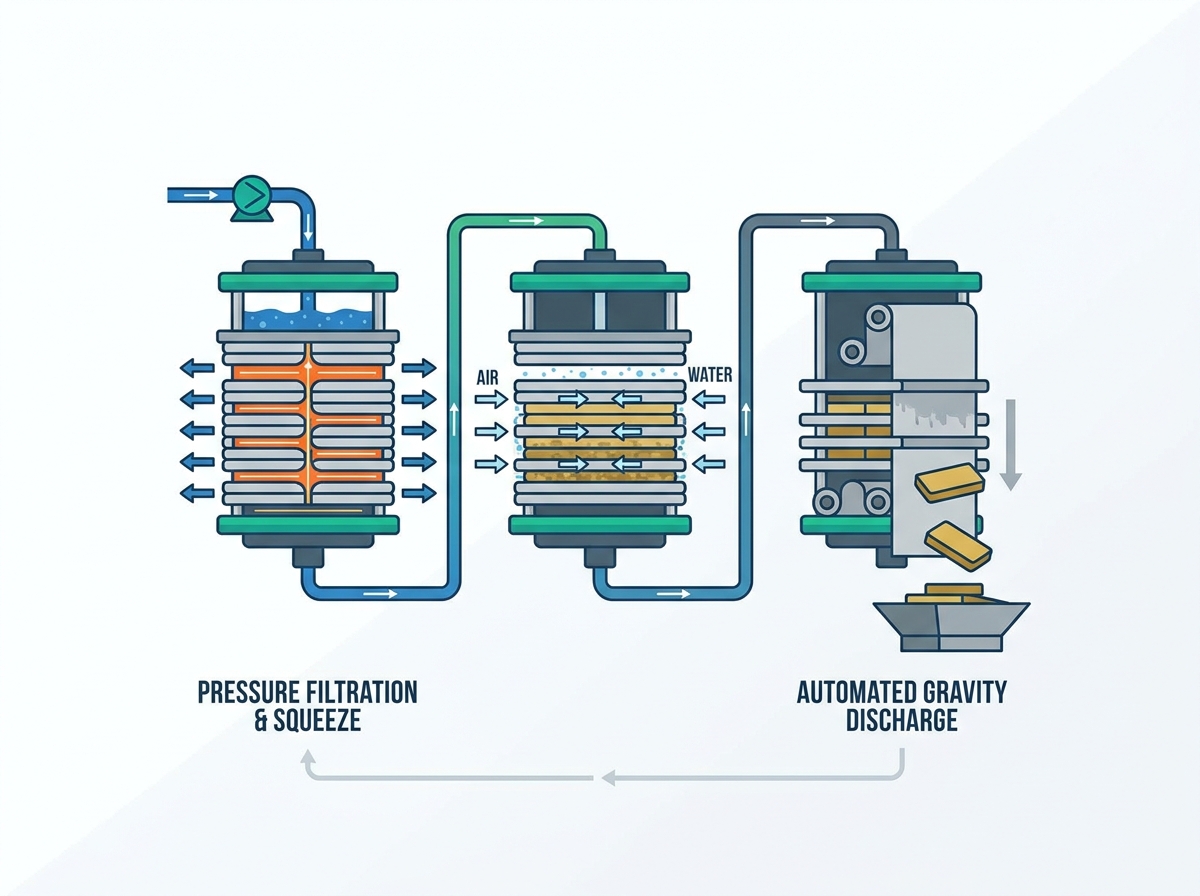
The operational process follows a highly controlled, sequential cycle. Understanding this step-by-step filtration cycle reveals the core efficiency of the equipment. A modern filter press automates these phases precisely.
Chamber Closing & Sealing: Heavy-duty hydraulic cylinders compress the plate stack downwards. This closure mechanism establishes a high-pressure, leak-free environment. Reliable sealing prevents hazardous slurry blowouts during operation.
Slurry Feeding: High-capacity pumps inject the raw material into the closed chambers. The liquid begins passing through the continuous cloth. Solid particles remain trapped inside the chamber gaps. Gravity ensures even material settlement.
Filtration & Squeezing: The system utilizes advanced diaphragm or membrane technology. Once the chambers fill, pressurized water or air inflates flexible membranes behind the cloth. This mechanical action forcefully compresses the filter cake. It squeezes out remaining interstitial liquid effectively.
Cake Washing & Air Blowing: Operators often need pure solid byproducts. The system pumps wash liquor through the compressed cake. It displaces impurities thoroughly. Next, compressed air blows through the cake matrix. This step mechanically displaces residual moisture.
Automated Discharge: The hydraulic system retracts. It opens the plate chambers simultaneously. Drive motors index the continuous filter cloth forward. Gravity pulls the dry cakes downward. They release rapidly onto a conveyor belt below. This enables entirely hands-free operation.
Industrial separation equipment must deliver tangible performance benefits. Facility managers prioritize solutions addressing specific operational bottlenecks. The vertical design offers several distinct engineering advantages.
Modern processing facilities often lack available floor space. Expanding building square footage requires massive capital investment. The vertical orientation builds upward rather than outward. It optimizes your existing facility footprint. You can install these units in tight spaces. They require significantly less linear floor space than long horizontal alternatives.
Manual intervention slows down production cycles. It also exposes workers to potential chemical hazards. Manufacturers integrate these presses directly with PLC and SCADA systems. Automation controls hydraulic pressures, feed rates, and cloth indexing. Operators monitor the entire process remotely. This drastically minimizes human operator intervention. It enhances workplace safety by removing personnel from active discharge zones.
Downstream transport costs depend heavily on material weight. Water weight adds unnecessary logistical expenses. The combination of high mechanical squeeze pressure and forced air blowing proves highly effective. It yields structurally stable filter cakes. These cakes contain remarkably low moisture levels. Drier cakes break apart easily during discharge. They reduce the burden on secondary thermal drying equipment.
Chemical processing often involves hazardous fumes. Some slurries release volatile organic compounds (VOCs) during separation. The stacked plate design facilitates complete enclosure. Manufacturers fit containment hoods around the machinery. These hoods capture harmful emissions safely. They route toxic vapors to facility scrubbing systems. This containment remains mandatory for strict environmental compliance.
Choosing the correct equipment architecture requires comparing multiple form factors. Each design excels in different operational scenarios. A clear comparison helps engineers justify their procurement choices.
Filter Press Architecture Comparison Chart
Feature | Vertical Press | Horizontal Press | Plate & Frame |
|---|---|---|---|
Operational Footprint | Compact (Builds upward) | Extensive linear space needed | Moderate linear space needed |
Labor & Automation | Fully automated cloth indexing | Semi-automated plate shifting | Highly manual cake scraping |
Cycle Times | Rapid, continuous batches | Moderate turnaround | Slow, labor-intensive turnaround |
Cake Discharge | Gravity-assisted simultaneous release | Sequential plate-by-plate release | Manual intervention required |
Horizontal models require extensive linear floor space. You must accommodate the full length of the plate stack plus the hydraulic ram retraction distance. A vertical unit builds upward. It utilizes overhead space efficiently. This allows you to fit high-capacity separation machinery into restricted plant layouts.
Traditional plate-and-frame models often require operators to physically scrape cakes off the cloths. This manual labor increases turnaround time drastically. A vertical system utilizes continuous cloth indexing. Drive motors pull the cloth over rollers. The cakes fall away naturally. This eliminates the need for manual scraping entirely.
Speed determines overall facility profitability. Sequential plate shifting in horizontal models slows down the discharge phase. A vertical machine opens all chambers simultaneously. The continuous cloth discharges all cakes at once. This continuous batch processing offers rapid cycle times. You can process more daily tonnage using fewer machines.
Horizontal models typically offer lower initial purchase prices. They feature simpler mechanical assemblies. This makes standard maintenance relatively straightforward. However, vertical models offset higher upfront setup costs through superior efficiency. They drastically lower long-term labor requirements. Drier cakes also reduce subsequent thermal drying demands. You conserve massive amounts of energy over the equipment lifespan.
Various sectors rely on advanced separation technologies to maintain profitability. Different industries present unique slurry characteristics. The robust design adapts well to these diverse challenges.
Mining operations generate massive volumes of slurry. You must separate valuable mineral concentrates from waste water. A specialized vertical filter press handles tailings dewatering efficiently. It recovers clean water for plant reuse. It also excels in rare earth processing. These applications demand high precision and extremely low cake moisture for transport.
The chemical sector deals with aggressive solvents and fine particulates. Producing petrochemicals and synthetic pigments requires strict quality control. Open-air separation risks product contamination. It also threatens worker health. The enclosed processing capabilities prove vital here. You safely contain hazardous materials throughout the entire filtration cycle.
Sanitation remains the top priority in food processing. Facilities separating edible oils, sugars, or starches require hygienic equipment. Traditional machinery harbors bacteria in crevices. Advanced vertical models support automated cleaning-in-place (CIP) protocols. The enclosed filtration environment prevents external contaminants from entering the product stream. This compliance meets strict FDA regulations.
Municipal and industrial wastewater treatment plants face mounting pressure. They must handle high-volume, difficult-to-dewater biological sludges. Standard methods leave sludges wet and heavy. High-pressure membrane squeezing drives out stubborn internal moisture. This reduces the total volume of sludge sent to landfills. It cuts disposal transportation fees significantly.
Selecting the right machinery requires rigorous technical evaluation. You cannot rely on baseline specifications alone. Buyers must align equipment capabilities with exact facility conditions.
Engineers must calculate daily tonnage accurately. You need to match the total chamber volume to your expected slurry flow rates. Undersized machines create severe production bottlenecks. Oversized units waste valuable utilities and space. You must determine the exact filtration area needed to hit production targets. Calculate batch times carefully to ensure continuous upstream operation.
Slurry chemistry dictates your hardware construction. Standard steel plates degrade quickly when exposed to acids. You must specify appropriate plate materials. Reinforced polypropylene offers excellent resistance to corrosive chemicals. It withstands harsh pH levels effectively. Furthermore, you must select filter cloths based on operating temperatures and particle abrasiveness. The wrong cloth weaves lead to frequent tearing and downtime.
Equipment reliability extends beyond the machine itself. You must evaluate the manufacturer thoroughly. Assess their standard delivery lead times. Verify their ISO certifications to guarantee manufacturing quality. More importantly, confirm the domestic availability of replacement parts. A broken hydraulic seal can halt production for weeks if spare parts require overseas shipping.
Off-the-shelf solutions rarely fit complex industrial applications perfectly. You must assess the available customization options. Many facilities require automated cloth washing systems to prevent blinding. Others need custom PLC programming to integrate with existing central control rooms. Modular scalability allows you to add extra plates later. You can increase capacity as your production volumes grow.
Deploying heavy industrial machinery involves inherent logistical challenges. Facility managers must prepare their infrastructure adequately. Ignoring these prerequisites leads to delayed commissioning and operational failures.
Installing these massive structures requires extensive rigging and crane work. The sheer weight of the vertical plate stack demands reinforced concrete foundations. You must coordinate heavy lifting equipment inside enclosed plant environments. Facility managers must schedule adequate downtime during the installation phase. Proper alignment of the vertical frame remains critical to prevent mechanical binding later.
This automated equipment consumes significant utilities. You must assess your existing facility capacity. The membrane squeezing phase requires high-volume compressed air or pressurized water. The massive closure cylinders demand robust hydraulic power units. If your plant air compressors lack sufficient CFM output, the squeeze cycle will fail. You may need to upgrade auxiliary utility systems before installation.
Transitioning from basic manual equipment introduces a steep learning curve. Maintenance teams must adapt to sophisticated mechanical systems. The continuous cloth tracking system requires precise sensor calibration. Misaligned cloths wrinkle and tear rapidly. Teams must also learn how to service high-pressure pneumatic seals. You must invest in comprehensive vendor-led training programs for your maintenance staff.
Slurry behavior remains notoriously unpredictable. Particle size distribution changes daily. You cannot procure industrial filtration equipment based on theory alone. Running lab-scale or pilot tests is absolutely necessary. You must test specific slurry samples taken directly from your process line. Pilot testing verifies cloth selection, required squeeze pressure, and expected cycle times. It eliminates the risk of full-scale performance failures.
Upgrading to an automated vertical separation system delivers immense strategic value. It optimizes restricted facility footprints while dramatically reducing manual labor requirements. The combination of high-pressure squeezing and air blowing guarantees superior cake dryness. This directly lowers secondary processing demands.
We recommend establishing a comprehensive decision matrix before purchasing. You should map out your exact slurry characteristics, physical footprint limitations, and utility constraints. Compare these metrics against vendor specifications carefully. Pay close attention to material compatibility and automated discharge capabilities.
Take proactive steps to validate your procurement strategy. Encourage your engineering team to request a material pilot test. Consult directly with an application engineer to verify your sizing specifications. Real-world testing remains the most reliable path to achieving long-term operational success.
A: The continuous filter cloth generally lasts between 3 to 6 months. Lifespan depends heavily on operational frequency and slurry abrasiveness. Highly acidic or alkaline materials can accelerate wear. Routine automated washing cycles extend cloth durability significantly. You must inspect the material regularly to prevent unexpected tears and costly unplanned downtime.
A: Yes, they routinely process highly abrasive materials like mineral tailings. Manufacturers utilize reinforced polypropylene plates and specialized wear-resistant filter cloths. We recommend specifying heavy-duty diaphragm materials to prevent premature degradation. Proper slurry feed control also minimizes high-velocity impact wear inside the individual filtration chambers.
A: Mechanical dewatering consumes substantially less energy than thermal drying. High-pressure squeezing and compressed air blowing remove most moisture mechanically. This drastically reduces the heat energy required for downstream processing. Facilities often observe significant reductions in daily utility usage when replacing thermal evaporation systems with advanced mechanical separation.
A: Most modern systems operate at diaphragm squeeze pressures up to 16 bar. Some specialized high-pressure models reach up to 30 bar. Higher pressures yield significantly drier filter cakes. You must ensure your facility's compressed air or hydraulic water systems can reliably sustain these peak load requirements during operation.