English
Views: 0 Author: Site Editor Publish Time: 2026-08-07 Origin: Site
Acquiring a vertical filter press represents a highly critical capital expenditure for modern industrial operations. A misaligned equipment choice quickly leads to recurring operational bottlenecks. You might face excessive maintenance demands if you select incorrectly. Suboptimal cake dryness also plagues poorly planned installations. Engineers understand standard horizontal filtration technology thoroughly. However, vertical configurations introduce specific automation variables. They also present unique footprint constraints. Pneumatic and hydraulic requirements demand rigorous evaluation before procurement. Process engineers need an objective framework for decision making. Procurement leads must evaluate technical specifications against actual production realities. We aim to help you align equipment capabilities directly with site constraints. This guide provides evidence-based strategies for optimizing your next major equipment upgrade. You will learn how to assess structural demands accurately. Read on to validate your next complex separation technology investment.
Vertical filter presses are optimal for operations requiring highly automated, continuous-batch processing within constrained physical footprints.
Slurry characteristics (pH, abrasiveness, particle size) dictate not just equipment type, but specific plate materials and filter cloth durability requirements.
Correct sizing relies on empirical pilot testing data, not theoretical maximums, to prevent chronic under-capacity or wasted CapEx.
Deciding between equipment configurations poses a fundamental business question. You must determine if a vertical orientation is mathematically justified. It must offer operational advantages over a traditional horizontal plate-and-frame filter press. You need evidence to support this significant structural shift. Engineers cannot base this decision merely on personal preference.
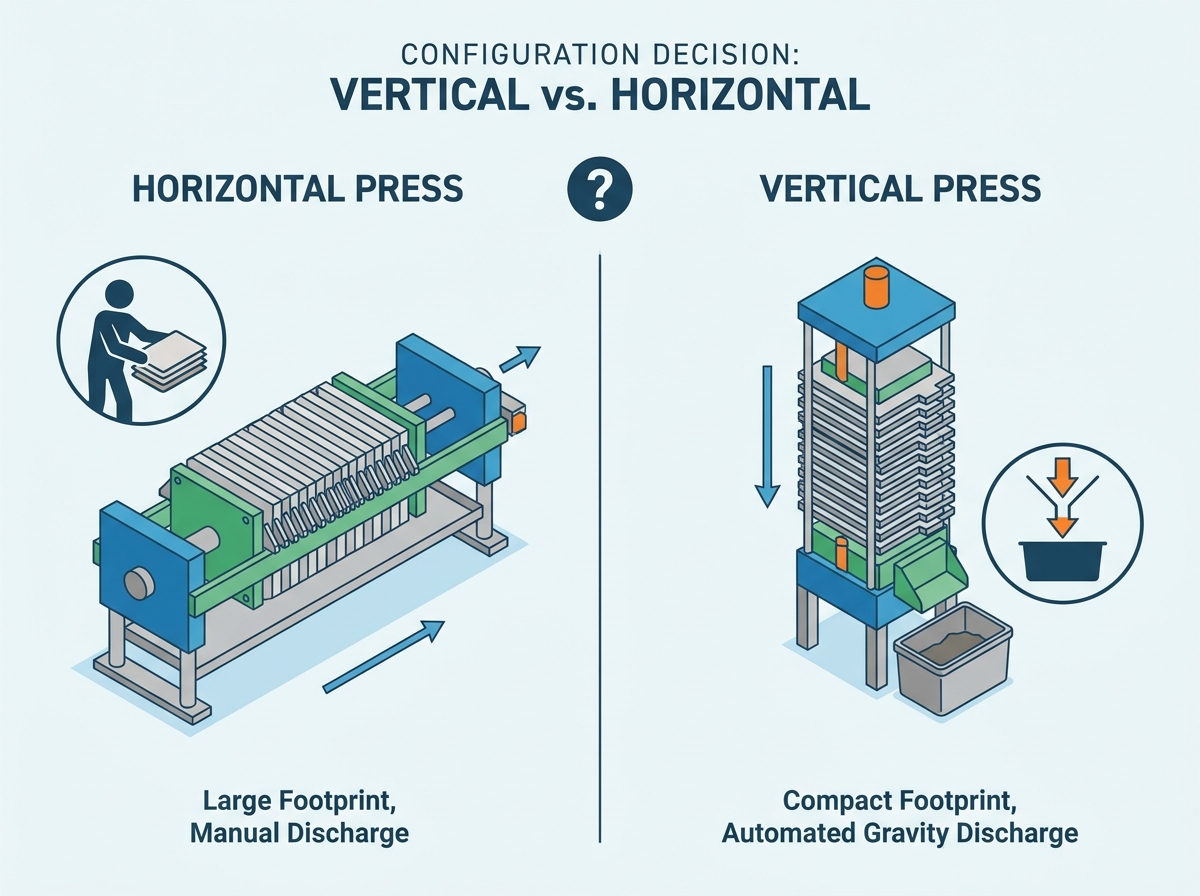
Compare floor space utilization directly. Vertical setups maximize upward spatial dimensions effectively. They prevent the sprawling horizontal footprint common in older manufacturing facilities. Space constraints often dictate equipment selection in crowded plants. However, you must carefully evaluate your building structure first. Consider ceiling height clearances for maintenance access. Evaluate the load-bearing capacities for elevated installations. These towering mechanical systems are incredibly heavy.
Automation provides a massive mechanical advantage. Gravity-assisted cake discharge speeds up operational cycles dramatically. This automated gravity process minimizes manual operator intervention entirely. High labor costs often justify the higher initial capital expense. You gain continuous-batch processing capabilities. Personnel can focus on system monitoring rather than manual scraping.
Assessment Feature | Vertical Configuration | Horizontal Configuration |
|---|---|---|
Floor Footprint | Highly compact floor area, demands high ceilings | Extensive floor area, requires low ceilings |
Cake Discharge Method | Gravity-assisted, fully automated release | Manual scraping or semi-automated shakers |
Labor Intensity | Minimal manual operator intervention required | Higher manual handling and monitoring required |
Batch Processing | Supports continuous-batch rapid cycling | Distinct, slower discrete batch cycles |
You must weigh these geometric factors against your plant limitations. Structural retrofits sometimes negate the spatial benefits of vertical designs. Always consult structural engineers before finalizing your location layout.
Chemical compatibility dictates your core material choices. You must match equipment materials to your specific extreme pH levels. Aggressive solvents appear frequently in chemical processing applications. Mining applications also present highly corrosive environments. You might specify reinforced polypropylene for acidic slurries. Stainless steel alloys work better for particular organic solvents. Material mismatch causes rapid chemical degradation.
Abrasiveness heavily impacts component lifespan. Mineral tailings behave exactly like liquid sandpaper inside pumps. High-wear slurries quickly degrade internal structural components. They wear down delicate sealing mechanisms rapidly. You need robust, abrasion-resistant parts for mineral processing. We recommend evaluating your particle size distribution carefully. Large, jagged particles accelerate wear significantly faster than smooth particles. Frequent seal replacements disrupt production schedules.
Operating temperatures also dictate structural integrity requirements. High thermal parameters stress standard polymeric materials. Heat influences your selection of specialized membrane plates. EPDM rubber handles moderate heat well. High-temperature environments might require advanced synthetic compounds. Heat can warp standard plastics over prolonged exposure. You must ensure your materials withstand peak operating temperatures safely.
Test slurry pH weekly to ensure ongoing material compatibility.
Monitor particle size changes after upstream crushing stages.
Record peak operating temperatures during summer production months.
Analyze solvent concentrations before changing feed sources.
Inspect sealing mechanisms monthly for early abrasion signs.
Failure to analyze slurry variables leads to catastrophic mechanical failures. You cannot swap core materials easily post-installation. Process variables define your baseline engineering requirements absolutely.
Filtration accuracy depends entirely on your media selection. You must understand the delicate relationship between weave patterns and performance. Weave styles directly impact micron retention ratings. Tighter weaves improve filtrate clarity dramatically. However, they restrict fluid flow rates noticeably. You must balance desired clarity against throughput demands.
Compare common materials for mechanical wear resistance. Polypropylene offers excellent broad-spectrum chemical resilience. It handles most neutral to acidic slurries perfectly. Nylon withstands high physical abrasion effectively. Mining sectors heavily rely on nylon media. Polyester handles high temperatures exceptionally well. You must match the fiber material against your specific chemical realities. Incorrect fibers degrade within days of installation.
Cake release efficiency prevents media blinding. Blinding halts production workflows completely. Sticky cakes refuse to drop during discharge cycles. Evaluate specialized surface treatments for your media. Calendered finishes improve cake release properties. Singed surfaces also prevent particles from embedding. Automated cloth-washing capabilities maintain consistent cycle times. High-pressure wash systems clean the media effectively. They prevent irreversible blinding over extended operational shifts.
Determine the target micron rating for required filtrate clarity.
Identify abrasive elements within the raw slurry mixture.
Select a weave pattern balancing flow rates and retention.
Specify surface treatments for handling sticky filter cakes.
Schedule automated wash cycles based on blinding frequency.
Media selection remains an ongoing optimization process. You will likely test several fabrics during initial commissioning. Keep detailed records of media lifespan for future purchasing decisions.
Engineers often rely heavily on static volume calculations. This theoretical approach frequently leads to massive undersizing. Theoretical maximums rarely match actual field realities. You must calculate equipment sizing based on dry solids throughput. Realistic cycle times provide much better capacity data. Avoid assuming continuous maximum flow rates from upstream pumps.
Pilot testing is absolutely mandatory for accurate sizing. Never skip bench-scale evaluations during procurement. Testing establishes accurate baseline filtration rates. It reveals your optimal cake thickness physically. You also discover the expected final moisture content. Empirical data prevents chronic under-capacity issues. You avoid wasting capital on improperly sized equipment. Pilot skids replicate production conditions accurately.
Consider future scalability during initial capacity planning. Build a sensible buffer into your design parameters. This capacity buffer accommodates expected future production increases. You will not need immediate equipment replacement later. Planning for a twenty percent capacity buffer works well usually. It provides crucial operational breathing room. Surges in upstream production will not overwhelm your separation stage.
Process bottlenecks often originate from poorly sized separation equipment. An undersized press becomes a permanent plant restriction. Over-sizing wastes floor space and initial capital. Precision sizing requires empirical evidence gathered through rigorous testing.
Energy and utility consumption require careful preliminary analysis. Highly automated systems consume significant auxiliary resources constantly. Compressed air drives the pneumatics and membrane squeezing sequences. High-pressure water feeds the automated cloth washing spray bars. You must ensure your facility supplies these utilities consistently. Pressure drops in plant air halt separation cycles immediately. Dedicated compressors often become necessary for reliable operation.
Maintenance and downtime realities impact production schedules directly. Servicing vertical drive mechanisms involves considerable mechanical complexity. Replacing continuous filter cloth belts takes extensive time. Horizontal plates often seem much simpler to service initially. You need highly trained technicians for vertical configurations. Specialized maintenance training minimizes unexpected downtime significantly. Rigging equipment is often required to move heavy vertical components.
Safety and environmental compliance remain paramount during installation. Some chemical processes handle highly hazardous or volatile materials. Toxic substances require fully enclosed filtration systems. You must assess these containment enclosures rigorously. They ensure you meet OSHA or regional equivalent safety standards. Proper containment protects your workforce effectively from exposure. Environmental agencies monitor airborne particulates closely today. Enclosed vertical systems mitigate fugitive emission risks efficiently.
Implementation requires aligning site capabilities with machine demands. Upgrading utilities adds time to your installation schedule. Plan your maintenance access routes before pouring concrete foundations. Foreseeable implementation risks are entirely preventable through thorough engineering reviews.
Choosing the correct equipment requires logical parameter balancing. You must weigh initial capabilities against expected operational efficiency. Slurry compatibility dictates your fundamental structural material choices. Maintenance realities determine your long-term production success. Properly aligned equipment eliminates recurring operational bottlenecks completely. You secure consistent throughput when specifications match reality.
Draft a rigorous Request for Proposal for your next step. Demand empirical pilot testing data from every potential vendor. Ask for verifiable case studies from similar industrial applications. Require explicit utility consumption breakdowns for air and water. Use this evidence-based framework for your final selection. It ensures your procurement meets exact production demands safely.
A: Vertical setups typically complete cycles much faster. Gravity-assisted discharge and automated membrane squeezing drive this efficiency. You can often reduce total cycle times by thirty percent. Continuous automated operations minimize manual intervention delays significantly.
A: You must conduct thorough laboratory testing first. Analyze your exact solids concentration and overall material compressibility. Highly compressible slurries respond exceptionally well to vertical membrane squeezing. Low-solids slurries might require separate thickening strategies upstream.
A: Persistently wet filter cakes indicate severe sizing issues. Excessive cycle times also reveal fundamental capacity mismatches. You might experience frequent media blinding rapidly. These symptoms show the machine cannot handle your actual dry solids throughput efficiently.
A: High-abrasion mining slurries degrade media very quickly. You might need full replacements every two to three months. Operational variables and cycle frequencies shift this timeline constantly. We highly stress selecting highly wear-resistant materials like heavy-duty nylon.