English
Views: 0 Author: Site Editor Publish Time: 2026-08-15 Origin: Site
Industrial dewatering processes frequently face operational bottlenecks related to sluggish cycle times, excessive floor space requirements, and suboptimal cake dryness. Plant engineers and facility managers must balance the need for maximum liquid-solid separation with strict limitations on facility footprint, labor costs, and maintenance downtime. Achieving high dry cake solids remains a persistent challenge across many processing plants, especially when dealing with fine or compressible materials. Understanding the exact mechanical sequence and engineering anatomy of a vertical filter press is critical for evaluating whether its gravity-assisted, automated design justifies the higher capital expenditure compared to traditional horizontal presses or centrifuges. By examining the step-by-step operation, facility operators can determine how high-pressure membrane squeezing and continuous cloth washing directly impact downstream thermal drying requirements and overall plant efficiency.
Gravity-Assisted Efficiency: Vertical filter presses utilize gravity for both uniform slurry distribution and rapid cake discharge, significantly reducing mechanical wear and cycle times.
Maximized Cake Dryness: The integration of high-pressure hydraulic membrane squeezing (up to 16–22 bar) and pressurized air drying phases yields exceptionally low residual moisture content.
Footprint Optimization: The stacked plate configuration requires up to 70% less horizontal floor space than conventional horizontal presses, though it demands robust vertical structural support.
Continuous Automated Operation: Continuous loop filter cloth washing and automated discharge mechanisms minimize operator intervention, lowering long-term OPEX.
The core structure relies on horizontally stacked plates that move vertically along heavy-duty guide columns. Hydraulic clamping cylinders compress the entire plate pack during operation. This massive clamping force allows the chambers to withstand extreme internal operating pressures, often exceeding 20 bar. The stacked configuration forms discrete, sealed filtration chambers. Each chamber provides a flat, uniform surface for cake formation. Precision engineering ensures tight seals between plates to prevent high-pressure blowouts. Operators must routinely inspect the guide columns for proper lubrication to maintain smooth vertical movement. The structural integrity of these plates dictates the maximum allowable feed pressure. Upgrading to reinforced polymer or specialized steel plates can extend the operational lifespan under harsh chemical conditions.
A single, continuous filter cloth belt weaves through all chambers. It travels in a distinct zig-zag pattern from top to bottom. A dedicated cloth drive motor advances the belt during the discharge phase. Guide rollers maintain proper alignment across the entire vertical span. Automatic tensioning systems keep the cloth taut, preventing wrinkles and ensuring uniform filtration. The continuous loop design enables simultaneous cake discharge across all chambers. This mechanism drastically cuts down cycle times compared to sequential plate shifting. Maintenance teams must monitor the pneumatic tracking sensors to prevent edge fraying. Selecting the correct weave and permeability for the cloth is essential for optimizing filtrate clarity and preventing premature blinding.
Flexible elastomer membranes integrate directly into the upper plates. Manufacturers typically use synthetic rubber, EPDM, or specialized polypropylene for these components. A high-pressure manifold system delivers water or air to inflate these membranes. Filtrate collection headers channel the extracted liquid away from the chambers. The inflation process physically compresses the filter cake. This mechanical squeeze extracts moisture far beyond standard pump pressure capabilities. The manifold requires regular pressure testing to identify micro-leaks before they cause system failure. Proper calibration of the inflation sequence prevents uneven pressure distribution, which could otherwise warp the filter plates or rupture the membranes.
The cycle begins by introducing slurry into the sealed, horizontally oriented chambers. The vertical orientation allows gravity to assist in symmetrical slurry distribution. Liquid spreads evenly across the entire filter cloth surface. This gravity-fed approach prevents uneven cake formation and eliminates localized high-wear zones on the filter media. Uniform distribution ensures consistent filtration rates across every square inch of the chamber. Operators control the feed rate using variable frequency drive pumps to match the specific gravity of the slurry. Proper feed distribution minimizes the risk of chamber blockages and ensures a homogenous cake structure for subsequent washing and squeezing phases.
The hydraulic clamping system seals the plate stack at high tonnage. A high-pressure feed pump forces the liquid slurry through the filter media. Solid particles accumulate on the cloth, creating the initial cake structure. Filtrate drains efficiently through the bottom grid of each chamber. Pumping continues until the chambers reach optimal solid capacity. This phase establishes the foundational structure of the filter cake. Monitoring the filtrate flow rate helps operators determine the exact moment the chambers are full. Prematurely ending this phase results in thin, wet cakes, while over-pumping can strain the feed pumps and cause bypass leaks.
Pressurized water or air inflates the flexible membranes. Operating pressures typically range from 16 to 22 bar. The expanding membranes physically compress the formed filter cake. This intense mechanical compression dewaters compressible cakes effectively. It pushes out liquid that conventional pumping pressure cannot remove. The squeezing phase drastically reduces the overall moisture content of the solids. Water squeeze systems generally provide more uniform pressure transfer than air systems. Operators must ensure the squeeze fluid is clean and free of particulates to prevent internal manifold blockages and membrane degradation.
Many applications require a dedicated cake washing phase. Wash liquor is forced uniformly through the compressed cake. This process displaces impurities or recovers valuable dissolved materials. The flat, uniform cake profile enables a highly efficient displacement wash. Wash liquid moves evenly through the solid matrix without channeling. This maximizes purity while minimizing wash water consumption. The following steps outline a standard wash sequence:
Introduce the primary wash liquor at a controlled low pressure to prevent cake disruption.
Monitor the electrical conductivity or pH of the effluent to determine wash completion.
Initiate a secondary squeeze to remove the excess wash liquor from the cake matrix.
High-velocity compressed air enters the chambers and passes through the filter cake. The air stream displaces remaining capillary moisture trapped between particles. This final drying phase achieves strict target dry solids criteria. It often eliminates the need for downstream thermal dryers entirely. Reducing thermal drying requirements significantly lowers overall plant energy consumption. The air blow duration depends heavily on the porosity of the cake. Highly compressible, fine materials may require extended air blow times or heated compressed air to achieve the desired residual moisture levels.
Hydraulic cylinders automatically open the plate stack. This action leaves a physical gap between each plate. The continuous cloth drive belt indexes forward. Cakes from all chambers discharge simultaneously off the ends of the plates via gravity. The belt then passes through a high-pressure wash chamber. Spray nozzles wash both sides of the cloth thoroughly. This restores cloth permeability before the next cycle begins. The automated discharge sequence eliminates the need for manual scraping. Routine inspection of the spray nozzles is necessary to ensure they deliver a uniform spray pattern, preventing localized cloth blinding.
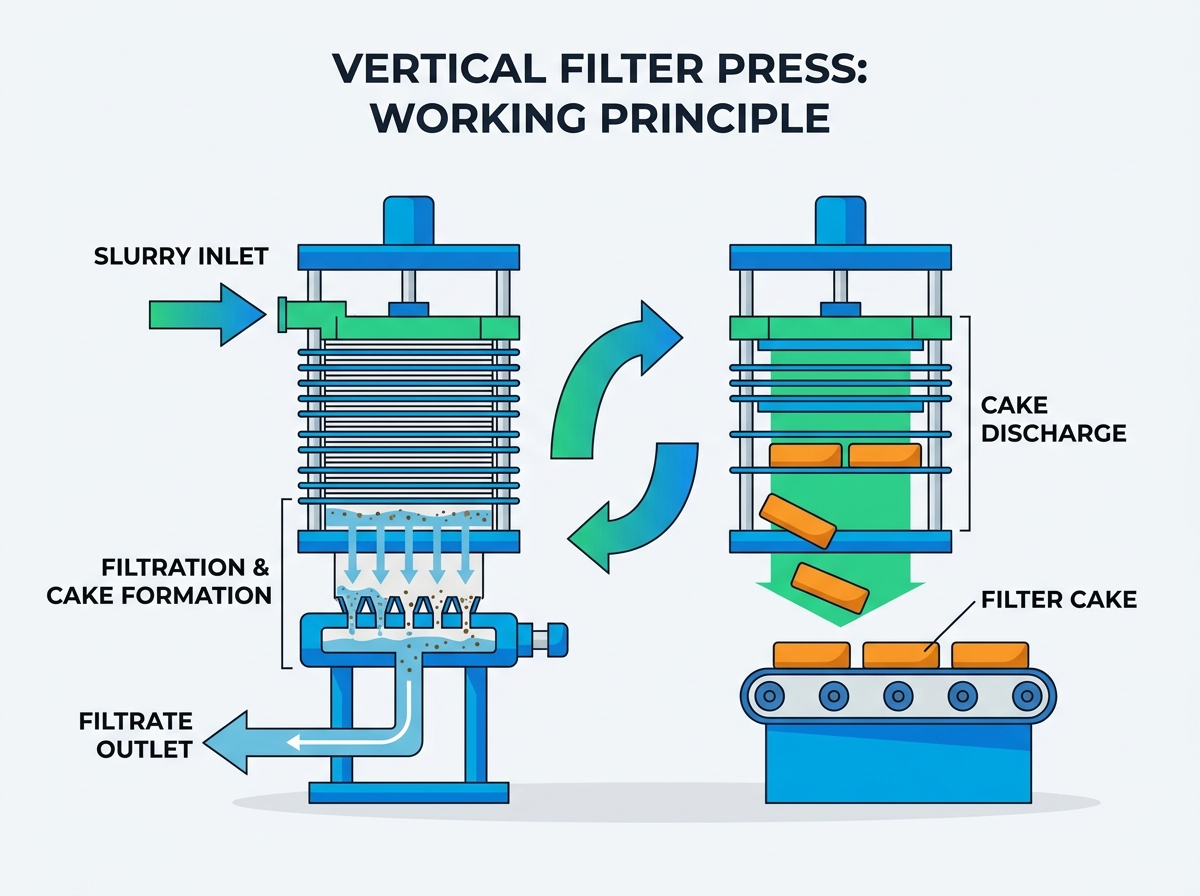
Vertical presses require high headroom and create concentrated heavy structural loads. They demand robust foundation engineering. In contrast, horizontal units need expansive, sprawling floor space. Facilities with limited square footage often benefit from the vertical footprint. However, engineers must account for the intense dynamic loads during operation. Proper facility integration requires careful structural analysis. The vertical design allows for easier integration with gravity-fed downstream conveyors. Facility planners must ensure adequate overhead clearance for maintenance cranes to lift the heavy plate assemblies during major overhauls.
Operational Metric | Vertical Filter Press | Horizontal Filter Press |
|---|---|---|
Floor Space Requirement | Compact (Vertical footprint) | Expansive (Horizontal footprint) |
Cake Discharge Speed | Simultaneous (1-2 minutes) | Sequential (15-45 minutes) |
Gravity Assistance | High (Aids feeding and discharge) | Low (Relies on pump pressure) |
Structural Load Profile | Concentrated, heavy vertical load | Distributed horizontal load |
Cloth Washing | Continuous, automated dual-sided | Periodic, often manual or semi-automated |
Simultaneous cake discharge via the moving belt saves massive amounts of time. Discharge often completes in under two minutes. Horizontal models rely on sequential plate-shifting, which can take 15 to 45 minutes. This speed allows vertical presses to achieve two to three times more cycles per day. Rapid-filtering materials see the highest throughput gains. Fewer moving parts during discharge also reduce long-term mechanical wear. The continuous belt system eliminates the repetitive stress on individual plate handles and shifting carriages found in horizontal designs. This translates to higher overall equipment effectiveness and reduced unplanned downtime.
Horizontal presses offer easier ground-level access to individual plates. Maintenance teams can inspect components without special equipment. Vertical presses require elevated access platforms for routine checks. However, vertical designs experience less structural wear on plate shifting mechanisms. The continuous belt system simplifies the discharge process. Facility managers must weigh accessibility against overall mechanical reliability. Implementing strict preventative maintenance schedules for the hydraulic power unit and cloth tracking sensors mitigates the risks associated with the more complex vertical architecture.
The high-pressure membrane squeeze and air-blow features directly impact operational costs. They produce exceptionally dry filter cakes. This reduces or eliminates thermal drying requirements. Facilities save significantly on fuel and electricity costs. Drier cakes also weigh less, reducing hauling fees for waste disposal. These outcomes directly justify the initial capital investment. When evaluating a vertical filter press, engineers should calculate the exact energy offset achieved by bypassing rotary dryers or fluid bed dryers. The moisture reduction often pays for the equipment upgrade within the first few years of operation.
Fully automated continuous cloth washing and gravity discharge offer high returns. Facilities with high labor costs benefit immensely from unattended operation. Continuous 24/7 operational environments require minimal operator intervention. Automated systems reduce human error and maintain consistent cycle times. The initial automation costs amortize quickly through reduced daily labor requirements. Modern control panels allow operators to monitor multiple units simultaneously from a central control room. This shift from manual operation to supervisory control drastically improves plant safety and workforce allocation.
Process slurry characteristics dictate necessary construction materials. Chemical aggressiveness, acidity, and temperature play crucial roles. Engineers often specify duplex stainless steel for wetted parts. Membranes require specialized elastomers to withstand harsh chemicals. Acid-resistant filter cloths prevent premature degradation. Selecting the correct metallurgy ensures equipment longevity and prevents catastrophic failures. For highly abrasive mining slurries, polyurethane-coated plates offer superior wear resistance compared to standard polypropylene. Evaluating the chloride content and operating temperature of the slurry is mandatory before finalizing the material specifications for the manifold and piping systems.
The concentrated static weight and dynamic hydraulic loads pose significant risks. A vertical press can easily overstress standard factory flooring or mezzanine structures. Mandate comprehensive structural engineering assessments prior to procurement. Design custom-engineered structural steel mounting frames. Implement advanced vibration isolation pads to absorb dynamic shocks during operation. Failure to adequately support the equipment leads to misalignment of the guide columns, causing severe mechanical binding and hydraulic seal failures. Consulting with civil engineers during the initial design phase prevents costly retrofits later.
Sticky, ultra-fine, or gelatinous particulates can blind the filter cloth. They can also cause the continuous belt to misalign and tear. Specify automated, dual-sided high-pressure cloth washing systems. Integrate optical or mechanical cloth tracking sensors. Use automated pneumatic correction rollers to keep the belt centered. Proactive tracking prevents costly downtime and cloth replacement. Operators should establish a routine chemical cleaning schedule for the cloth to dissolve embedded scale or organic fouling that the high-pressure water sprays cannot remove.
High-pressure hydraulic leaks or valve wear cause immediate, costly downtime. Membrane failures halt production entirely. Implement predictive maintenance protocols on all hydraulic power units. Require redundant pump configurations for critical lines. Maintain a local inventory of proprietary seals, membranes, and pinch valves. Quick access to spare parts minimizes operational disruptions. Utilizing high-quality, fire-resistant hydraulic fluids enhances safety in high-temperature processing environments. Regular oil analysis helps detect internal pump wear before it leads to a catastrophic failure.
Calculating required filtration area prevents over-sizing or under-sizing. Base calculations on daily volumetric throughput and solid concentration. Target cycle times dictate the necessary chamber volume. Proper sizing avoids wasted capital expenditure and operational bottlenecks. Engineers must test specific slurries to determine optimal cake thickness. Accurate parameters ensure the equipment meets daily production targets. A cake that is too thick will not wash or dry efficiently, while a cake that is too thin reduces overall throughput. Pilot testing provides the empirical data needed to finalize these critical dimensions.
Mining and metallurgical operations use these presses for high-density mineral concentrates. Copper, iron, and zinc processing require rapid cycles and massive throughput. Chemical and pigment processing rely on precise displacement washing. Food and pharmaceutical applications demand sanitary dewatering. They require Clean-in-Place capabilities and FDA-approved food-grade materials. Containment of volatile organic compounds is also critical in these sectors. The enclosed nature of the vertical chamber design makes it ideal for handling hazardous solvents or toxic precipitates safely.
Initiate pilot-scale filtration testing with the specific process slurry to accurately validate filtration rates and cake thickness parameters.
Evaluate cake washing efficiency and finalize optimal filter cloth selection based on empirical test results.
Determine the optimum membrane squeeze pressures required to meet target moisture levels before finalizing procurement specifications.
Conduct a thorough structural engineering assessment of the proposed installation site to ensure it can handle the dynamic loads.
A: Cycle times generally range from 8 to 25 minutes depending on slurry characteristics, cake thickness, and required dryness. This is significantly faster than horizontal presses due to simultaneous mechanical belt discharge.
A: It utilizes a dual-action mechanism. Physical high-pressure hydraulic membrane squeezing up to 22 bar eliminates void spaces. This is followed immediately by high-flow compressed air blowing to displace residual capillary moisture.
A: They excel with fine, fast-settling, compressible, or highly valuable solids. Common applications include mining concentrates, metallurgical tailings, chemical processing, pigment manufacturing, and industrial waste treatment.
A: Modern vertical presses use automated tracking systems featuring pneumatic or optical sensors. These detect minor belt deviations and dynamically adjust the tensioning and alignment rollers to keep the cloth centered.
A: Installations require heavy-duty structural steel framing or reinforced concrete foundations. These must support the high static weight of the stacked plates and the intense dynamic forces generated during hydraulic clamping and belt advancement.
A: Yes, modern vertical filter presses are designed for fully unattended, lights-out operation. They integrate automated feeding, squeezing, washing, air blowing, cake discharge, and cloth washing controlled via a centralized PLC or Distributed Control System.