English
Views: 0 Author: Site Editor Publish Time: 2026-08-04 Origin: Site


For continuous, high-throughput solid-liquid separation, process engineers face a critical decision. You often must choose between batch processing equipment, like filter presses, and continuous vacuum systems. Batch systems interrupt process flows. They demand intensive labor and complicate downstream handling. Conversely, a horizontal vacuum belt filter provides a continuous, highly controllable filtration process. It specifically excels where intense cake washing and extremely low residual moisture remain critical to your success.
In this article, we move beyond basic definitions. We provide an engineering-focused breakdown of how this equipment functions. You will learn about operational risks, structural variants, and maintenance realities. We also cover the exact criteria for evaluating if it fits your specific facility's CapEx and OpEx constraints. This ensures you make an informed, data-backed equipment selection.
Horizontal vacuum belt filters utilize gravity and continuous vacuum suction to separate slurries, enabling multi-stage cake washing without interrupting the process flow.
Success depends heavily on matching the filter variant (e.g., rubber belt vs. enclosed) to the chemical properties and volatility of the slurry.
While they offer superior continuous throughput compared to filter presses, they require a significantly larger physical footprint and specific maintenance protocols for moving wear parts.
Proper sizing requires pilot-scale material testing to determine filtration rates, required vacuum levels, and optimal cake thickness before full-scale deployment.
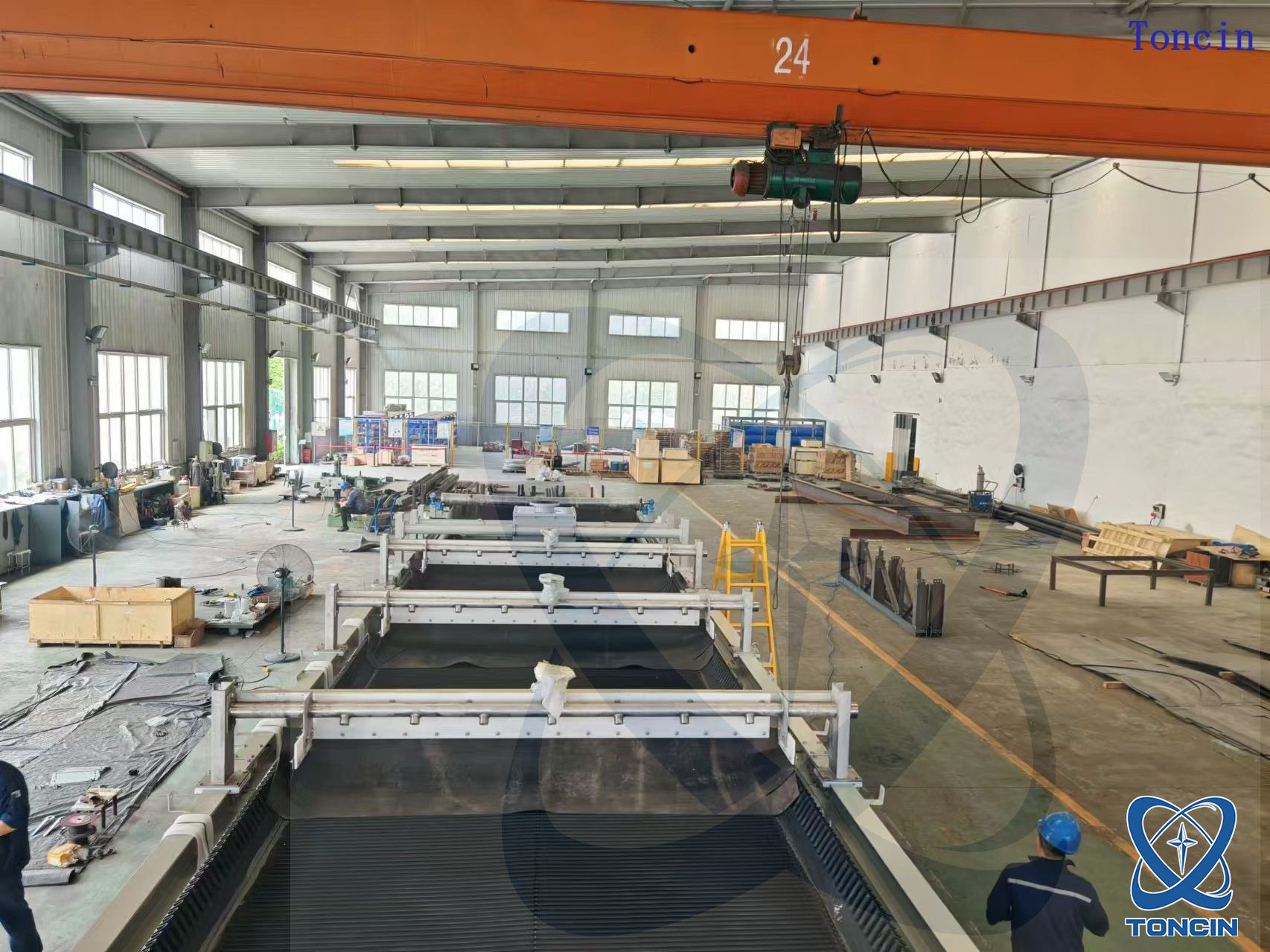
To understand this equipment, you must view it as a moving drainage deck rather than a static pressure chamber. The system operates on a continuous loop mechanism. It uses a motorized drive pulley to pull a porous filter cloth across a slotted drainage belt. Gravity and vacuum suction work together. They rapidly separate liquid filtrate from solid particles. We can divide this continuous operation into four distinct phases.
Phase 1: Slurry Feeding. The process begins at the feed end of the machine. A specialized feed distributor pours the slurry onto the moving filter cloth. This distributor plays a critical role. It ensures an even layer of material spreads across the entire width of the belt. An uneven layer leaves thin spots. Vacuum suction will always take the path of least resistance through these thin spots. This phenomenon, known as vacuum channeling, ruins filtration efficiency.
Phase 2: Filtration and Vacuum Extraction. As the belt moves forward, it passes over a stationary vacuum box. This box sits directly beneath the belt. It generates strong negative pressure. The vacuum forcefully draws the liquid filtrate through the porous cloth. The liquid enters the grooves of the carrier belt. It then flows through center drainage holes into the vacuum box. From there, piping transports the filtrate to external receiver tanks.
Phase 3: Cake Washing (The Primary Advantage). The remaining solids form a filter cake on the cloth. The belt transports this cake into the washing zone. Here, spray bars distribute clean wash fluid over the cake. You can configure this zone for co-current or counter-current washing. Counter-current washing allows you to reuse wash fluid from later stages in earlier stages. This drastically reduces overall solvent consumption. Note: This true multi-stage washing capability gives horizontal vacuum belt filters a massive competitive advantage over centrifuges. Centrifuges cannot easily perform discrete, multi-stage washes without re-slurrying the product.
Phase 4: Drying and Discharge. After washing, the cake enters a final vacuum drying zone. The vacuum pulls ambient air through the cake to displace remaining moisture. The belt then reaches the discharge roller. The cloth separates from the carrier belt and sharply changes direction. This action causes the dried cake to peel off and fall into a collection chute. Finally, high-pressure water jets wash both sides of the empty filter cloth. This prevents blinding before the loop restarts.
Manufacturers design several distinct structural variants of this equipment. You must match the specific configuration to the chemical properties of your slurry. Choosing the wrong variant leads to premature equipment failure or safety hazards.
The standard industrial configuration is the Rubber Belt Vacuum Filter. This design utilizes a heavy-duty, grooved elastomeric drainage belt to support the filter cloth. The rubber belt provides exceptional tensile strength. It effortlessly handles the mechanical stress of continuous heavy loads.
Evaluation lens: Process engineers select this variant for heavy industrial mining, mineral processing, and aggressive chemical slurries. The thick rubber withstands highly abrasive materials like silica sand or metal ores. You can specify natural rubber, EPDM, or specialized synthetic blends based on the slurry's chemical makeup.
Some processes involve highly volatile or toxic solvents. In these cases, an open-air filtration system poses severe risks. You must use an Enclosed Vacuum Belt Filter. This configuration surrounds the entire moving deck in a gas-tight housing. Operators often purge the enclosure with nitrogen. This eliminates oxygen and prevents explosive atmospheres.
Evaluation lens: You need this variant for solvent-based slurries, hazardous vapors, or strict environmental compliance requirements. However, you must weigh the trade-offs. Gas-tight housings require significantly higher initial capital expenditure. Furthermore, the enclosure restricts physical access. This makes routine maintenance and cloth replacements much more complex and time-consuming.
Municipal and industrial effluent streams present unique challenges. The suspended solids are often organic, slimy, and highly compressible. A specialized Wastewater Vacuum Belt Filter addresses these issues. These units often feature extended gravity drainage zones before the vacuum engages.
Evaluation lens: Focus on the equipment's ability to handle variable feed concentrations. Wastewater streams rarely maintain a steady consistency. Success here relies heavily on chemical conditioning. You must carefully dose polymer flocculants into the slurry. The filter relies on these flocculants to group fine particles into larger, drainable clusters.
Before committing to procurement, process engineers must critically evaluate facility constraints. This equipment solves many problems, but it is not universally applicable. You must compare its characteristics against batch processing alternatives.
The most obvious trade-off involves physical space. A horizontal vacuum belt filter delivers continuous, high-volume output. It never stops to discharge or clean itself. However, it requires a massive physical footprint. A typical unit can easily span 15 to 30 meters in length. You must ensure your facility has adequate floor space. If space is tight, vertical filter presses might be your only viable option, despite their batch limitations.
Use the following comparison chart to determine if your slurry profile matches the strengths of this continuous vacuum technology.
Process Factor | Ideal Fit (Choose Vacuum Belt) | Poor Fit (Avoid Vacuum Belt) |
|---|---|---|
Particle Fragility | Fragile floccules requiring gentle, zero-shear handling. | Hard, durable particles that can withstand extreme mechanical squeezing. |
Washing Requirements | Multiple, distinct wash stages needed to recover valuable solutes. | No washing required, or simple single-stage displacement is sufficient. |
Cake Compressibility | Rigid, fast-draining cakes that form rapidly under gravity/low vacuum. | Highly compressible, slimy cakes that blind the cloth and require high-pressure squeezing. |
Production Flow | Strictly continuous, uninterrupted downstream processing required. | Batch production schedules where intermittent discharge is acceptable. |
You must balance the initial investment against long-term operational realities. A vacuum belt filter typically commands a high capital expenditure. However, you must also look closely at operational expenses. You will consume significant electrical energy running continuous vacuum pumps. You will regularly purchase replacement filter cloths. You must also supply a steady volume of clean wash fluid. On the positive side, automation drastically lowers operator labor costs compared to manual filter presses.
Transparency regarding maintenance builds realistic expectations. Moving heavy machinery constantly under vacuum creates specific wear points. You cannot install this equipment and ignore it. You must implement rigorous, proactive maintenance protocols to ensure uptime.
The interface between the moving rubber belt and the stationary vacuum box creates constant friction. Manufacturers install sliding wear strips (usually made of UHMW polyethylene) to manage this. They also inject lubricating water along these friction belts.
Best Practice: Monitor lubricating water flow constantly. Inspect wear strips monthly.
Common Mistake: Running the belt dry. This generates immense heat, melts the wear strips, and immediately destroys the vacuum seal.
The filter cloth must travel perfectly straight. If it drifts sideways, it will wrinkle. Wrinkles break the vacuum seal and allow solids to bypass the cloth. This ruins filtrate clarity. Therefore, modern units utilize automated pneumatic or hydraulic tracking systems.
These systems use edge sensors to detect drift. They automatically pivot tensioning rollers to steer the cloth back to the center. You must keep the air supply to these pneumatic systems clean and dry. A failed tracking system will quickly tear an expensive filter cloth.
Over time, fine particles embed themselves deep within the filter cloth weave. This phenomenon, known as blinding, chokes off filtrate flow. To mitigate this downtime risk, manufacturers install high-pressure wash stations on the return run of the belt.
You must ensure these wash nozzles provide overlapping coverage. Check nozzle pressure daily. If nozzles clog, blinding will rapidly spread across the cloth. You will see a sudden drop in production throughput and an increase in residual cake moisture.
Purchasing this equipment is a major engineering project. You cannot simply select a model from a catalog. You must follow a rigorous, data-driven specification framework.
Empirical data is absolutely non-negotiable. You must start with bench-scale filter leaf tests. Send representative slurry samples to the vendor's laboratory. These tests determine specific cake resistance and the optimum cloth weave. They also establish required wash ratios. Once bench tests look promising, rent a small pilot unit. Run it at your facility to validate performance under real plant conditions.
Engineers use the pilot data to calculate the required active filtration area. This area is typically measured in square meters. When specifying a Large-Scale Vacuum Belt Filter, sizing depends on the slowest rate-determining step. Sometimes the cake forms instantly, but drying takes a long time. The equipment size must accommodate the longest phase of your specific separation process to achieve the target throughput.
Evaluate all wetted parts based on your slurry chemistry. You must analyze the pH, temperature, and chloride content. Standard applications use stainless steel 304 or 316L. Highly corrosive environments might demand Duplex stainless steel. Alternatively, you can save capital by specifying rubber-lined carbon steel for highly acidic, low-temperature slurries.
Do not evaluate vendors solely on the initial purchase price. Assess their local aftermarket support. Ask where they stock critical wear parts like belts, seals, and cloths. Finally, evaluate their willingness to offer mechanical and process guarantees based on the pilot test results. A confident vendor will stand behind their empirical sizing data.
The horizontal vacuum belt filter stands as the premier choice for continuous, easily controllable filtration.
It provides unmatched, multi-stage counter-current washing capabilities that preserve valuable solutes and reduce solvent waste.
Your ultimate decision hinges on balancing your physical footprint constraints against the financial return of high-purity cake recovery.
Do not guess at equipment sizing. Gather empirical data first to protect your capital investment.
Next Step: Contact an application engineer to request a technical consultation. Submit a representative slurry sample for laboratory bench-testing to determine your exact filtration parameters.
A: A vacuum belt filter utilizes continuous suction and gravity to gently pull liquid through a filter cloth. It excels at washing and handling fragile cakes. A belt press uses dual converging belts to apply intense mechanical squeezing and shearing forces to force liquid out. Belt presses are better for highly compressible municipal sludge, while vacuum filters are superior for chemical and mineral processing.
A: Cake thickness varies dramatically based on the material properties. It typically ranges from 3mm for very fine, slow-filtering chemicals, up to 100mm for coarse, rapid-draining mineral ores. You must optimize this thickness during pilot testing. A cake that is too thick restricts vacuum flow, while a cake that is too thin causes vacuum channeling.
A: The lifespan depends on chemical exposure, the abrasive nature of the slurry, and proper maintenance. With excellent care of the wear strips and tracking systems, a heavy-duty rubber belt usually lasts several years. Conversely, operators must replace the thinner woven filter cloth much more frequently, often every few weeks or months, due to blinding or mechanical wear.